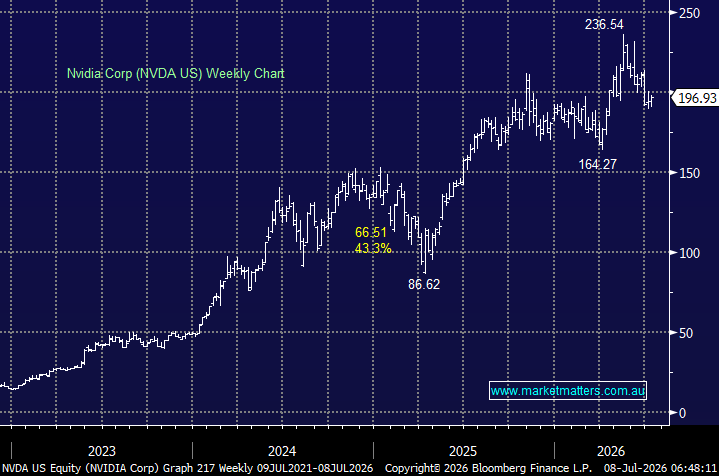
NVIDIA is the defining infrastructure company of the AI boom, supplying the GPUs, networking, systems and software that power increasingly complex data centres. The quality of the business is well understood; what interests us now is that the valuation is becoming increasingly attractive relative to the earnings growth still being delivered.
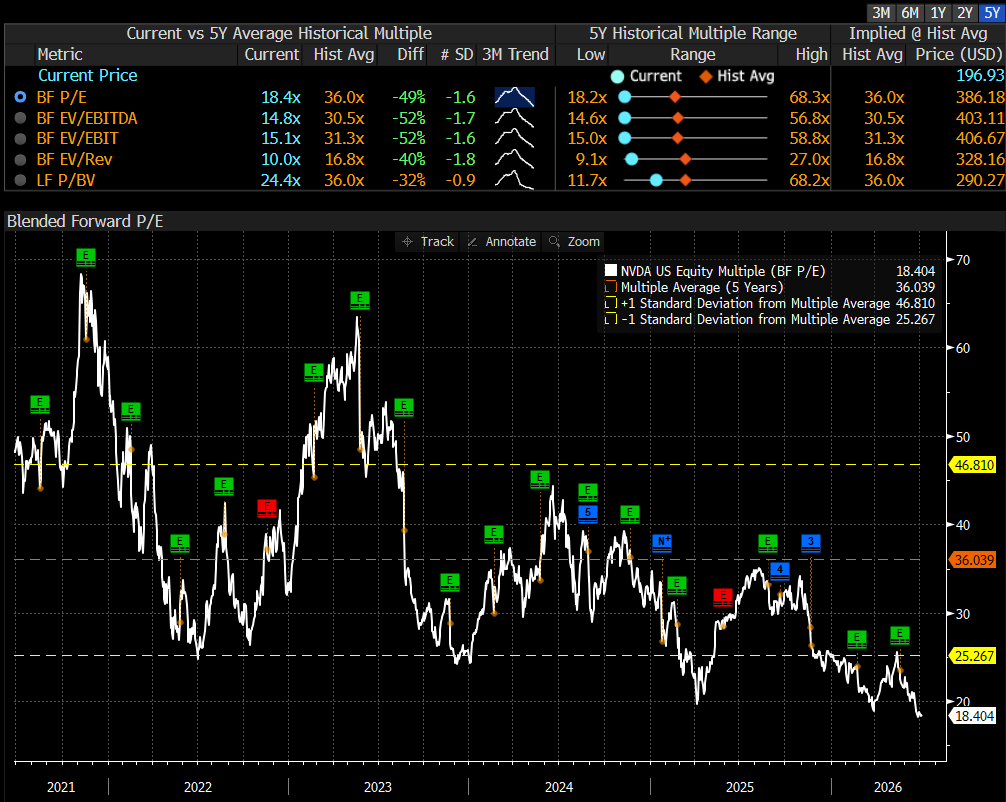
At around US$196, NVIDIA trades on ~19.5x next year’s consensus earnings. Consensus expects revenue to rise from around US$214 billion in FY26 to US$393 billion in FY27 and US$561 billion in FY28, while EPS is forecast to almost triple over the same period. On FY28 estimates, the stock trades on only around 15x earnings.
chart

Nvidia (NVDA US) Valuation – Source Bloomberg
chart
Nvidia (NVDA US) Valuation – Source Bloomberg
The latest quarter reinforced the strength of the business. Revenue rose 85% to US$81.6 billion, Data Centre revenue increased 92% to US$75.2 billion, gross margins recovered to 75%, and operating margins reached 65.6%. These are exceptional numbers for a company of NVIDIA’s scale and highlight the operating leverage in the model.
The central bear case is that the AI infrastructure cycle is nearing a peak. We think that concern is already being reflected in the multiple, while the underlying demand backdrop remains strong. Hyperscalers, neo-clouds, enterprises and governments are still increasing spending on AI capacity, with compute increasingly linked to productivity and revenue generation rather than simply experimentation.
NVIDIA’s moat also extends well beyond its GPUs. Its full-stack offering spans chips, CPUs, networking, complete systems and CUDA software, creating high switching costs and making the platform difficult to replicate. Competition from AMD and custom silicon will increase, but NVIDIA remains the dominant ecosystem.
The next catalyst is the rollout of the Vera Rubin platform in the second half of 2026, alongside the company’s expansion into standalone data centre CPUs. This should broaden NVIDIA’s addressable market and maintain its rapid product cadence beyond Blackwell.
The risks we think are well under stood by the market. The company remains exposed to concentrated hyperscaler spending, China restrictions, greater competition and the possibility that AI capital expenditure slows. Expectations are also high, meaning any product delay or earnings disappointment could drive volatility.
However, we believe the market is applying a lower multiple to a business that is still delivering extraordinary revenue growth, margins and cash generation. NVIDIA is not cheap in absolute terms, but it looks cheap relative to its earnings growth, competitive position and quality.
- We are adding NVIDIA (NVDA US) to the Market Matters International Hitlist, with a view to buying the stock.
MM is bullish NVDA ~$US196
Add To Hit List