Hi Bill,
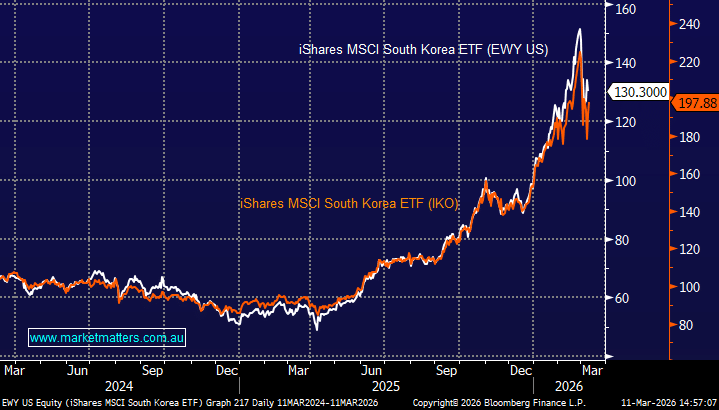
As the chart below illustrates the performance of the two is very similar:
- The EWY is a US-listed ETF providing exposure to the South Korean equity market, heavily weighted to semiconductor giants like Samsung Electronics and SK Hynix.
- iShares MSCI South Korea ETF (IKO) is an ASX-listed ETF that provides direct exposure to the South Korean equity market, again dominated by major tech names like Samsung Electronics and SK Hynix.
MM focused on the EWY ETF due to its size – its the global “go to” for Korean facing exposure:
- The EWY is huge with a market cap in excess of $US17bn whereas the IKO has a relatively tiny market cap of $A126mn, or about 1.3% of the size.
From a comparison perspective they both have pros and cons:
- Due to its size the EWY tends to have far more depth and most importantly tighter spreads.
- The IKO is simple to trade on the ASX, has no tax implications as you mentioned plus its denominated in $A which MM is bullish through 2026.
In terms of volatility you’re broadly on the right track. The Korean market is heavily influenced by retail investors, who account for a large share of trading, well over 60% of trading volume. These investors/traders are more willing to use margin and leveraged products, which can amplify market swings and increase volatility. In contrast, Japanese investors have historically been more cautious, holding large amounts of cash and relying more on institutional investment, which tends to dampen volatility. China and Hong Kong markets can also be volatile, partly due to significant retail participation and sentiment-driven trading, though Chinese households overall have traditionally preferred property, gold and cash over equities.
In terms of SMSF’s (or other Australian entities investing in the US), it is a well trodden path, with a very clear set of rules.
When investing in the US, an Australian investor signs a US tax form (W-8BEN) which tells the US Internal Revenue Service (IRS) that we are not a US taxpayer, but rather a resident of another country (e.g. Australia). Because Australia has a tax treaty with the US, filling out this form means dividends earnt in the US incur 15% withholding tax (30% if no form is filled out). The form confirms we are not subject to US tax filing requirements. Further, we can then generally claim it as a foreign income tax offset when declaring the dividend in an Australian tax return. In terms of capital gains, no tax is applied in the US – it is paid in Australia (if applicable). Noting, Market Matters does not provide tax advice, and investors should seek advice from an accountant with regard to tax matters. We are simply relaying how investing in the US works in practice.