Hi David,
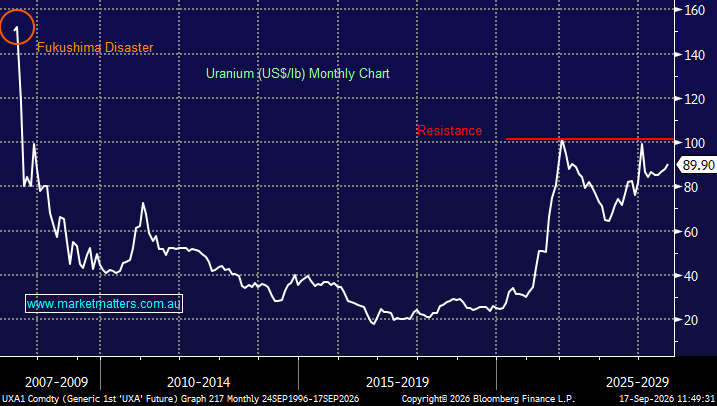
We feel it’s all about timeframes and not getting too close to respective markets and caught up in their day-to-day noise. Depending on where you draw the line uranium is trading up 4-5 times higher than it was going into COVID. Over the same time frame the likes of Paladin (PDN) has surged ~30x as the producers became financially viable at current higher levels.
However, as we all know markets rarely go up (or down) is straight lines, especially after such strong initial moves. Uranium is currently trading ~10% below its post-COVID high which remains bullish from our perspective, it’s simply consolidating its 5–6-year advance, but we need another trigger to take the nuclear fuel above the psychological US$100 level.
As we’ve discussed through 2026, the uranium market is increasingly moving toward a structural supply deficit, with the main debate now centred on timing rather than direction. Primary mine supply has lagged reactor requirements for years, with inventories and secondary supply helping bridge the gap, while most forecasts see the balance tightening materially into the 2030s. Near-term estimates vary but the longer-term setup is much clearer.
- The OECD/IAEA’s 2026 Red Book has warned that new projects need to be advanced now to avoid a supply squeeze from the mid-2030s, particularly given that major greenfield uranium mines can take 15–20 years to permit and develop.
As members know demand is being supported by a broadening nuclear renaissance. Reactor capacity is expected to rise sharply over the next decade, led by China and India, while planned closures in Europe are increasingly being deferred. AI-driven data-centre power demand is adding another layer to the story as technology companies seek reliable, low-carbon baseload power, including nuclear offtake agreements.
Supply remains highly concentrated, Kazakhstan alone produces around 40% of global output, and although new supply from Uzbekistan, North America, Namibia and Canada should help, the pipeline still looks insufficient without materially higher incentive prices.
- We believe uranium prices are trending higher over time but it’s not a week-to-week cycle.
In short, the uranium bull case rests on a simple mismatch, demand is accelerating, while supply takes years to respond and stocks like Paladin (PDN) are only now starting to become profitable, after building up to full nameplate capacity, with long-term AISC expected to decline to the mid-to-high $30s/lb range as operations stabilise at full capacity, i.e. if/when uranium breaks back above US100/lb the miners will follow suit.
You make an interesting and valid point on fundamentals taking a back seat. In the US, only about 10-15% of trading now comes from fundamental investors, with the rest split between quant funds, high-frequency traders and short-term retail activity.