Hi Glenn,
You’re right that the operating numbers at Regal Partners (RPL) look decent:
- Funds under management rose 2.4% in the September quarter to about $21.9bn, the 12th consecutive quarter of inflows, with FUM plus commitments now around $23bn.
- At the 1H26 result, normalised net profit roughly doubled (up ~108%) to more than $93mn, helped by a record $1.4bn of net inflows for the half.
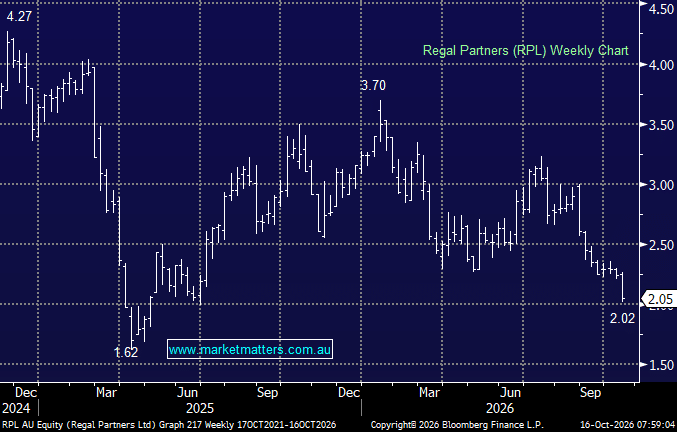
However, the shares are down around 20% year-to-date and sit close to the bottom of their 52-week range of roughly $2.27 to $3.70.
The two main reasons the shares have been sliding are the departure of Phil King and poor recent performance of Regal’s equity strategies across the board.
Key person risk – The market is struggling to price Regal without Phil King:
- His retirement was announced on 24 August, and the shares fell ~9% on the day.
- He remains in the business until June 2027, transitioning towards retirement over that time.
- He is keeping an 8% stake in RPL, which is a signal of confidence in the business he’s leaving behind.
Performance – Regal’s equity strategies have had a very tough year. Over the past 12 months:
- Australian Long Short, the flagship: -18.9%
- Tactical Opportunities: -25.4%
- Global Small Companies: -18.4%
- Atlantic Absolute Return: -17.2%
- Australian Small Companies: -16.3%
- Tasman Market Neutral: -12.7%
Only the resources strategies have held up, with Resources High Conviction up 23.4%.
This matters for the share price in two ways. First, performance fees, which drove much of the recent earnings growth, are unlikely to come through from funds sitting this far below their high-water marks. That puts a question mark over FY27 earnings. Second, flows follow returns, so a weak year in the flagship strategies tends to show up in redemptions with a lag.
We’re holders of RPL but are cautious on buying today. Phil King’s departure and the poor 12-month performance across the equity funds are likely to weigh on sentiment, and on performance fees, until returns turn. The valuation is undemanding, but we’d want to see the flagship strategies back on track before adding.
For subscribers who don’t know Australian Finance Group (AFG), it’s one of Australia’s largest mortgage aggregators. It gives its network of mortgage brokers access to lenders, products and support, and it also writes its own AFG-branded home loans through that network.
The shares have been sold off hard this year down ~42% year-to-date at around $1.27, near the bottom of their 52-week range, despite a decent FY26 result:
- Net profit rose 39% to $49mn.
- Around 90% of earnings now come from recurring, diversified sources.
- FY26 dividends totaled 9.5c fully franked, a yield of roughly 7.5%, and the company is buying back shares.
The key concern is credit risk through its own-branded lending, AFG carries exposure to its home loan book and with interest rates staying high, the market is worried about rising arrears and the potential for bad debts, as well as slower loan volumes across the broker network. We also think these sorts of businesses are susceptible to AI driver displacement – this is exactly the sort of platform business that could be displaced/hurt by AI driven alternatives – i.e. competition is only likely to intensify.
The stock looks cheap on paper, but with rates elevated, credit risk building in the loan book and the threat of AI disruption, it’s not one for us.