Hi Dario,
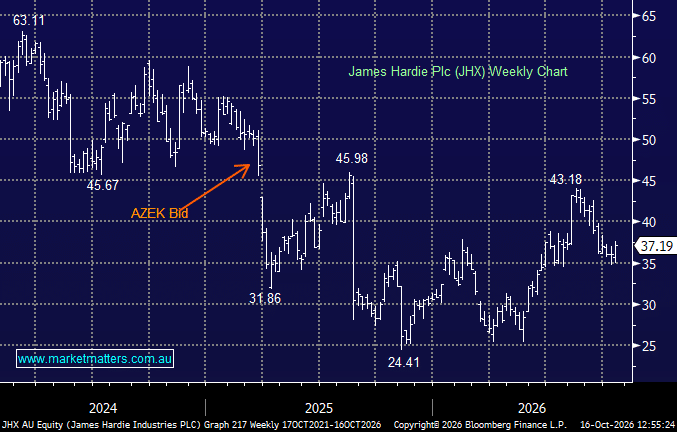
The near-term earnings picture for JHX looks reasonably safe:
- At its September investor day, JHX reiterated its 2Q and FY27 guidance.
- Free cash flow guidance was upgraded to $600mn+.
- The $125mn cost synergy target from the AZEK deal is now expected a year early.
- UBS has 2Q EBITDA of ~$407mn, comfortably inside the $399–435mn guidance range.
- A conservative 2H guide has lowered the bar.
So we’re not expecting a disappointment at the result though the market largely knows this already. Important to note with JHX – the stock trades on ~19x forward earnings and leverage is ~2.7x following the AZEK acquisition. Its share price remains tightly correlated with US homebuilders.
The US housing backdrop has had its struggles:
- 30-year mortgage rates are up ~80bp since the Middle East conflict began.
- Single-family starts are below their long-term average.
- Existing home turnover remains stuck due to “rate lock”.
All in all we think JHX looks positive, however we switched our exposure from JHX into REH earlier this year and remain comfortable with that call. REH still gives us leverage to a US recovery, but with a more balanced earnings base. A meaningful share of its earnings comes from Australia and NZ (REH ~45% vs JHX 12%). It has also kept investing in its US network through the downturn, which should pay off when activity turns.
As for Cameco, the fade in Cameco (CCJ) after last week’s spike has less to do with uranium and more to do with the jitters sent through markets in terms of sentiment towards AI.
- The Nasdaq and S&P 500 had their biggest one-day fall since July on Wednesday, after hot inflation data raised expectations of further Fed rate hikes.
- The 20 largest global AI and semiconductor stocks lost more than $1 trillion in value this week, as rate hikes, AI financing and competition weighed on sentiment.
This is important for CCJ because the AI power story has been a big part of its re-rating. The argument runs that hyperscalers need enormous amounts of reliable baseload power, nuclear is the answer, and uranium demand follows. If investors start doubting how much data-centre capacity actually gets built, and whether it can be financed at higher rates, that’s a negative for CCJ.
Uranium itself is holding up well. The commodity is sending a very different message to equities:
- The long-term contract price finished September at $96.50/lb, above its 2007 peak of $95, with spot at $89.63.
- In the near term, slow short-term contracting by utilities has kept spot subdued.
- On Cameco’s own commentary, utilities still haven’t bought enough uranium to fully replace what their reactors consume. That suggests a lot of procurement is still to come.
We see four catalysts:
- The 3Q result – Cameco reports before the market opens on Friday, October 30. They had a weak 2Q, where EPS missed expectations by a wide margin even though revenue was in line. They need a better a result this time round, plus commentary on stronger contracting at higher prices would help.
- Uranium pricing – A sustained move in spot through the ~$90 ceiling, and term prices pushing towards $100.
- Reassurance on AI spending –The hyperscaler earnings season is close. If they reaffirm or lift capex, the read-through for power demand gets repaired quickly.
- AI debt markets reopening – If credit spreads for the debt-heavy data-centre operators settle and financing deals start getting done again, the “can it be funded” fear fades. That would take pressure off the whole energy-for-AI complex.
We expect CCJ to trade sideways in the low-to-high $80s in the near term, rather than make a clean trend change. The uranium fundamentals are as strong as they have been this cycle, but the stock won’t decouple from AI sentiment while rate-hike fears and AI debt concerns dominate. We’d want the low-$80s support to hold through that result, and some steadying in the AI trade, before calling a new uptrend. We still like it, and think the medium term fundamentals remain solid.