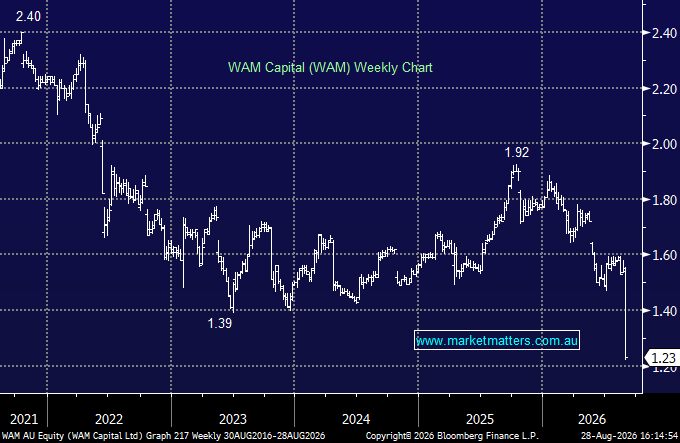
WAM – 18.54%: has finally fallen on its sword and announced a dividend cut for FY27 – something they should have done a while ago. While the Board maintained the FY26 full-year dividend at 15.5c per share, partially franked at 60%, it has cut its FY27 target to just 8.0c per share, comprising two 4.0c dividends.
The prospective dividend has effectively been cut by almost 50%, and for a stock that has attracted a large retail following because of its income stream, the market reaction is understandable. More importantly, today’s announcement goes directly to the issue we have been raising with WAM for some time.
The attraction of WAM has always been obvious on the surface: a long history of relatively consistent dividends and, until recently, an extremely high headline yield. But those distributions have not always been supported by the returns being generated by the underlying portfolio. As we have previously written, LICs can smooth dividends by drawing on accumulated profit reserves, which works for a period of time but ultimately reduces the capital backing of the fund if investment performance is not sufficient to replenish those reserves. WAM has now effectively acknowledged exactly that.
The company said that since FY20, dividends paid have exceeded profits generated, requiring the Board to draw down accumulated profits reserves. Following payment of the FY26 final dividend, that reserve is expected to fall to just 5.6c per share, below the 7.75c required simply to maintain the existing interim dividend.
The headline yield was never free. Part of it was effectively being funded from reserves built up in prior periods, and once those reserves became depleted, the dividend had to be reset.
The underlying investment performance has also been poor. WAM’s portfolio fell 10.5% in FY26, compared with gains of 5.7% for the All-Ordinaries Accumulation Index and 8.1% for the Small Ordinaries Accumulation Index. That represents underperformance of 16.2% and 18.6% respectively over the year. Over five years, WAM’s investment portfolio has returned 5.8% p.a., versus 7.4% p.a. for the All Ordinaries, while its 10-year return of 8.8% p.a. also trails the broader market’s 9.5% p.a.
The FY27 target of 8c per share is designed to rebuild the profit reserve and preserve capital, but even that target is not guaranteed. WAM will need to generate additional investment profits during FY27 to fund both dividends. Based on portfolio performance to 27 August, it expects the reserve to improve to around 6.9c per share, still below the full 8c target.
This is why we have been uncomfortable with the stock despite its apparently attractive yield. When we last looked at WAM (here), the shares were trading at a sizeable premium to NTA, meaning investors were paying well above the value of the underlying portfolio for the privilege of receiving that dividend stream. That made little sense to us given the performance record, the fee structure and the risk that the premium could disappear if confidence in the dividend weakened.
Today, the stock has been hit by both a dividend reset and a valuation reset. The market had placed considerable value on WAM’s ability to maintain a 15.5c annual distribution, and once that assumption broke, so did a significant part of the premium investors were prepared to pay.
The final FY26 dividend of 7.75c, partially franked at 60%, will still be paid in October, but thereafter the income profile looks materially different. WAM says an 8c FY27 dividend would equate to a 6.6% cash yield and an 8.3% grossed-up yield, calculated against its July pre-tax NTA of $1.2117 rather than the share price – although, both are pretty close now.
At some point, weakness can create opportunity, and WAM is clearly less expensive today than it was yesterday. However, we would be careful assuming the lower share price alone makes it attractive. The real question is where the stock settles relative to NTA once the premium attached to the old dividend policy is stripped out.
We have been critical of WAM because we felt investors were focusing too heavily on the headline yield and not enough on what was supporting it. Today’s announcement validates that concern. The dividend was being supplemented by reserves, portfolio performance has not been strong enough to sustain the payout, and the Board has now been forced to reset distributions sharply lower.
- The sell-off looks dramatic, but in our view, it is less a new problem emerging today and more the market finally recognising a problem that had been building for some time
MM still has no interest in WAM
Add To Hit List