One way to diversify exposure across private credit managers is through the LEND ETF, although it offers a very different proposition to traditional private credit funds such as those managed by Metrics. Rather than investing directly in underlying loans, LEND holds shares in 28 of the world’s largest listed private credit companies, providing indirect exposure to more than 3,950 borrowers across its portfolio at launch. Established in February 2024, the AUD-hedged ETF charges a 0.65% management fee, pays monthly distributions and has grown to more than $200m in assets.
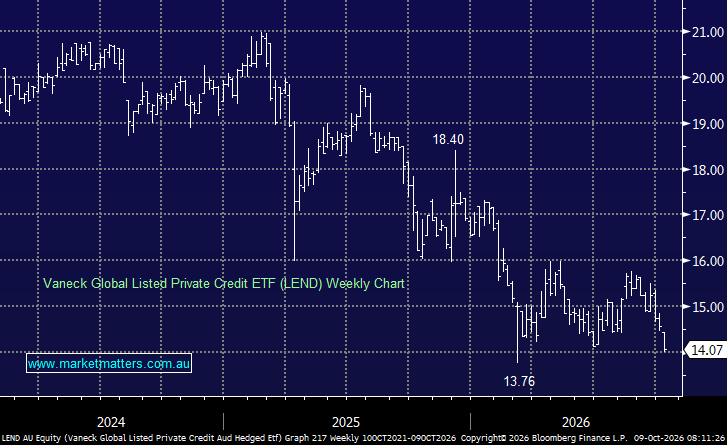
- LEND has offered a distribution yield of more than 12% over the past 12 months, but its unit price has fallen a painful 16.6% in 2026 alone — a timely reminder that high income doesn’t necessarily translate into attractive total returns.
The important distinction is that LEND is an equity ETF, not a traditional fixed-income investment. Investors are exposed to both the underlying credit cycle and sharemarket volatility, with the fund falling more than 5% in October alone. While its global portfolio provides diversification away from Australia’s property-heavy private credit market, it introduces a different set of risks, including equity valuations and investor sentiment towards listed credit managers.
Unlike traditional unlisted private credit funds, LEND provides daily liquidity through the ASX, without the same fund-level redemption restrictions. However, that liquidity doesn’t protect investors from capital losses. Indeed, during periods of market stress, listed private credit companies can reprice sharply, even when the performance of their underlying loan portfolios remains relatively stable.
LEND is therefore an accessible and liquid way to gain diversified exposure to the global private credit industry, but its double-digit distribution yield comes with meaningful equity-market risk. As recent performance demonstrates, when sentiment turns against the sector, investors should expect LEND to behave much more like an equity investment than a traditional income fund.
When investing in private credit, our preference remains for carefully selected funds that invest directly in underlying loans, rather than an ETF holding shares in the companies that originate and manage them. We believe this provides more targeted exposure to credit returns, without introducing an additional layer of equity-market volatility.
MM is neutral towards the LEND ETF around $14
Add To Hit List
chart

VanEck Global Listed Private Credit ETF (LEND)
chart
VanEck Global Listed Private Credit ETF (LEND)