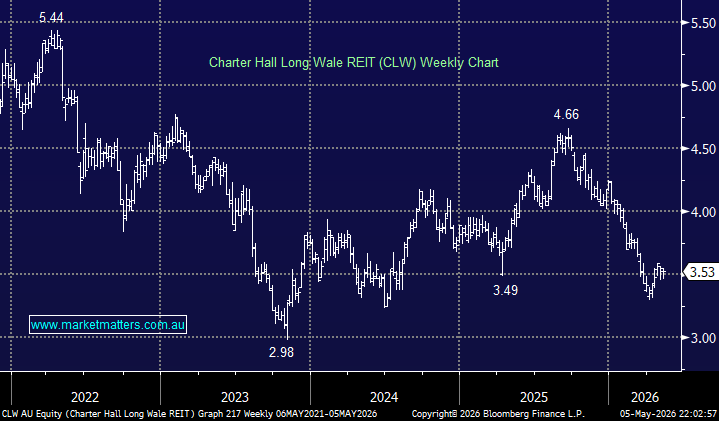
We are tweaking our property exposure in the Income Portfolio, selling out of Centuria Capital (CNI) and buying Charter Hall Long WALE REIT (CLW). This is not a negative call on CNI, which we continue to view as a well-run business with attractive longer-term growth options, and we will still hold the position in the Emerging Companies Portfolio. Rather, this is a portfolio construction decision, with the key driver being risk.
CNI has done a good job navigating a difficult property market. Its recent result showed a business moving from preservation mode back toward growth, with assets under management now above $20bn, solid momentum in real estate finance through Centuria Bass, and genuine optionality emerging through ResetData. Management has been recycling capital sensibly, selling mature assets and redeploying into higher-return areas such as healthcare, real estate credit and AI/data infrastructure. We like that strategy, and we still see CNI as a credible income-and-growth exposure.
However, CNI is ultimately an asset manager, and asset managers are more cyclical than direct property owners. Earnings are more exposed to transaction activity, fund flows, capital markets conditions and investor appetite for new products. When property markets are improving, that operating leverage is attractive. When conditions are patchy and rates remain elevated, it also brings more risk.
CLW offers a different exposure. It is a more defensive, income-focused REIT with long leases, high occupancy and a tenant base skewed toward government and large corporates. Its WALE of around 9.3 years and occupancy near 99.9% provide strong visibility over rental income, while the portfolio is diversified across office, industrial, logistics, retail, data centres and social infrastructure. In simple terms, CLW is a lower-growth but lower-risk property exposure.
CNI offers more upside if property markets recover and capital recycling accelerates, but it also carries more earnings variability. CLW is more bond-like, and therefore sensitive to interest rates, but it provides more dependable contracted income. With the market already having adjusted to higher rates and CLW now offering an attractive unfranked yield of 7.3%, we think the risk/reward has materially improved.
This also fits our current macro view. We think the market has become too aggressive in pricing further RBA tightening. If the RBA holds rates steady or becomes less hawkish, bond yields should ease, which would improve the relative appeal of CLW’s income stream and support its unit price. Conversely, if the environment remains tougher for longer, CLW’s defensive tenant base and long lease profile should offer better downside protection than a more cyclical property asset manager.
While we still like CNI as a business, for the Income Portfolio, we want to always be mindful of cyclicality and improve the quality and visibility of income. CLW gives us more defensive property exposure, a strong yield, long leases and lower operational risk. This is a risk-management switch rather than a wholesale change in our view on property. We are moving from a higher-beta property growth exposure into a more dependable income stream, which we think is the right balance for the current environment.