What makes the current setup different is that the AI trade is no longer operating in isolation. While valuations are not stretched, there is some concern that current demand/sales could be “as good as it gets”, while rising bond yields, elevated oil prices and geopolitical uncertainty are simultaneously putting pressure on risk assets. More importantly, the increasingly interconnected nature of the AI ecosystem creates the potential for a domino effect: if hyperscalers slow spending, the impact could quickly flow through to chipmakers, data-centre developers and the growing pool of debt and circular financing supporting the build-out.
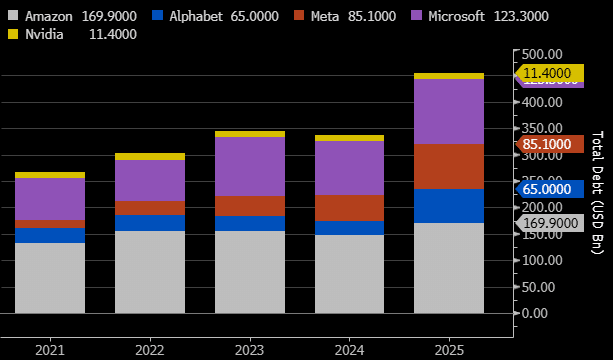
The sheer cost of the AI arms race is increasingly showing up on hyperscaler balance sheets, with combined debt rising 71% from US$267bn in 2021 to US$456bn in 2025 as companies supplement enormous operating cash flows with external financing. Amazon carries the largest debt load at US$170bn, although much of this reflects its broader logistics and infrastructure footprint, while Microsoft’s debt has climbed from US$80bn to US$123bn alongside its OpenAI investment and Azure expansion. The most dramatic shift has been at Meta, where debt has surged from just US$14.5bn to US$85bn, while Alphabet more than doubled its borrowings in 2025 to US$65bn. Nvidia remains the notable exception, with debt broadly unchanged at around US$11bn as booming AI-related earnings have allowed it to self-fund growth.
Importantly, rising gross debt does not necessarily imply balance-sheet stress: Alphabet and Nvidia remain firmly in net-cash positions, while Microsoft and Meta have moved into net debt as investment has accelerated. However, the direction of travel is important. The AI build-out is becoming increasingly capital-intensive and reliant on both cash flows and debt markets, creating another potential pressure point if AI spending slows, earnings disappoint or borrowing costs remain elevated.
- The US hyperscalers are feeling the heat, like Scott Bessant, as long-term bond yields continue to rally: overnight, the US 30s were trading ~5.38%, testing their highest level in two decades.
Even the perception that AI growth may be poised to slow is likely to trigger amplified moves across the market, given how much optimism is already embedded in AI-related stocks, i.e. last night could easily just be the beginning over the coming months.