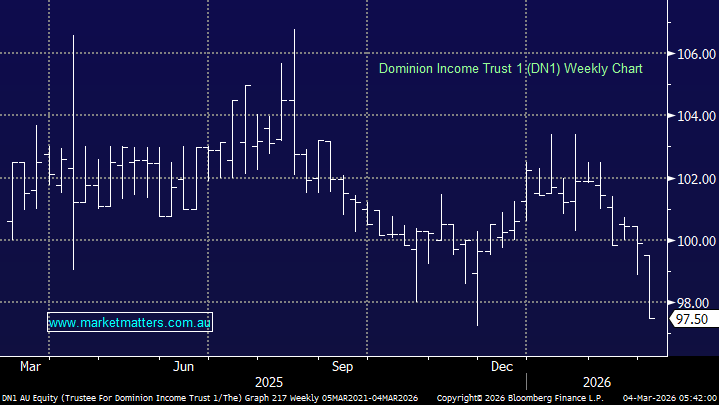
The Dominion Income Trust (DN1) is an Australian listed investment trust (LIT) managed by Dominion, which is a brand of Realm Investment House, a locally based credit and fixed income manager overseeing approximately $7.4bn. Realm has a long history in Residential Mortgage-Backed Securities (RMBS), although today it invests broadly across structured and private credit markets.
Last week, a UK mortgage originator – Market Financial Solutions (MFS) – collapsed into administration amid allegations it pledged the same collateral multiple times to secure funding. If proven, that behaviour is fraudulent and illegal.
Yesterday, Realm confirmed it has exposure to MFS within its Realm Strategic Income Fund of approximately 2.2%, via a mezzanine financing position. DN1 has some exposure to that Fund. After speaking with Realm, they confirmed DN1’s look-through exposure is approximately 0.5%, or around $1.75m of the ~$350m in DN1, i.e. a low level. Importantly, DN1 has an equity buffer within its structure:
- Dominion absorbs the first 4% of losses (≈$10m).
- Only once that subordinated capital is exhausted would losses begin to impact DN1 investors.
In other words, even in a full write-down scenario, DN1’s exposure would sit well within that buffer. (As an aside, DMNHA — Dominion’s other listed income note — has no exposure to MFS.)
So, what happened at MFS?
MFS was a UK-based specialist mortgage and bridging finance lender focused on short-term, property-backed loans, with a loan book of roughly £2.4bn. This does not appear to be a normal credit loss. While it’s still early days, administrators have alleged that MFS pledged the same assets multiple times as collateral for different loans, creating a significant shortfall between committed loans and genuine underlying security.
- Early disclosures suggest that against ~£1.16bn of loan commitments, only around £230m of “true” collateral value may exist. If accurate, that’s a substantial mismatch.
In a note out yesterday, Realm talked about how they protect against these sorts of things happening, having an independent security trustee (to control the collateral), a facility agent (to monitor compliance with agreements) and an external account banker (to control the cashflow). They also highlighted that three significant UK/European banks conducted financial background checks and provided senior loans or banking services to the facility, and the collateral underpinning the loans was also independently audited twice in less than a year.
While this shows a depth of process, and we still view Realm as a good manager, it does highlight the opaque nature of private credit. Increased returns above cash come with increased risks – that’s just the way it works! We would also suggest that Realm (or any other manager) disclose early (rather than after an AFR article – which happened in this instance). Transparency matters!
While it’s only early days, and Realm will have a good crack at restoring value by taking over collateral (if there is any left), their worst case scenario will be a full write down of the loan, impacting their Strategic Income Fund by ~2.2%, and DN1 by ~0.5%, which (in the case of DN1) would be covered by the equity buffer. This would be the first test of this sort of structure for these newly listed ASX securities that have come to prominence since APRA made the strange decision to phase out Tier 1 bank hybrids.
What are the broader implications?
The collapse has reignited concerns about transparency, valuation and leverage within parts of the private credit market. Unlike public bonds, private debt isn’t regularly marked to market or disclosed, and this creates a false illusion of low volatility – something MM has spoken about in the past (such as here). You might also recall JP Morgan’s CEO Jamie Dimon flagging concerns about the opacity and rapid growth of private credit, which is becoming a large, less transparent area of the market, making risks harder to see until stress emerges. His comment at the time rings true today: “When you see one cockroach, there are probably more.”
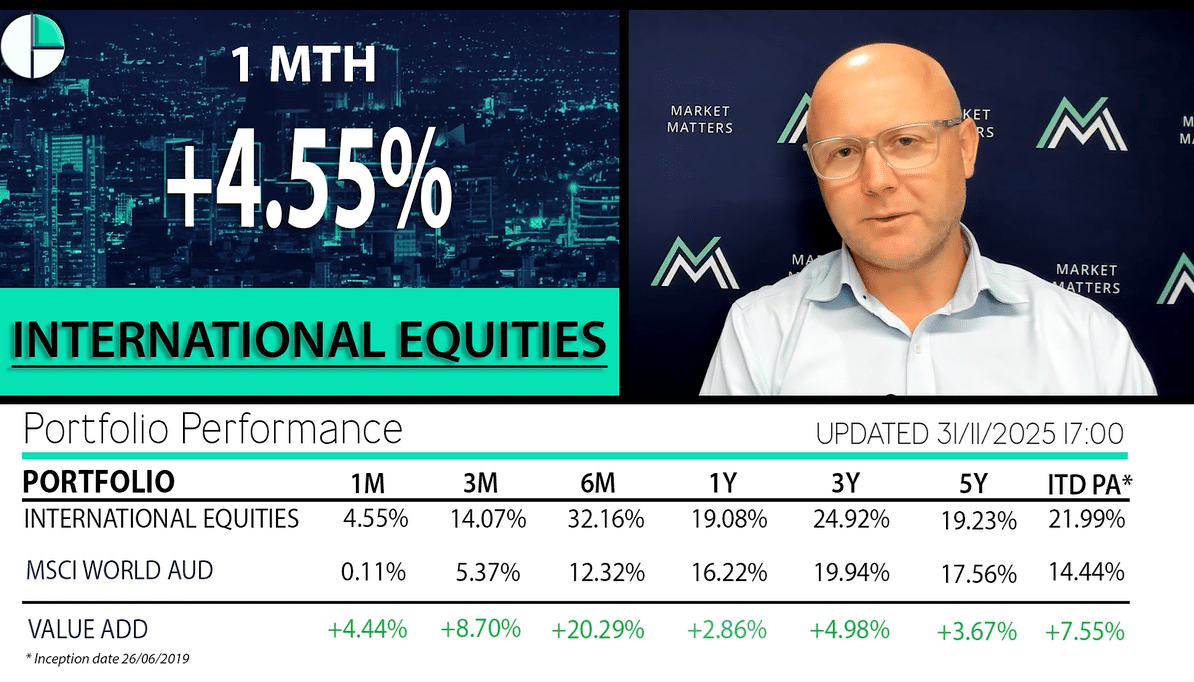
Global alternative managers, including KKR, Blackstone (which we own in the International Equities Portfolio – discussed last week here), Apollo Global Management and Blue Owl Capital have all sold off aggressively, but this isn’t solely about MFS. There are also broader concerns about private credit exposure to software businesses facing AI disruption – cash flows once considered stable may be less predictable, and asset values underpinning loans may need to be reassessed.
The collapse of MFS does not look like a broad systemic failure, but it has been the catalyst to raise more questions about risk disclosure and valuation in private credit – and rightly so.
How should we react?
We’ve cautioned investors about having too much private credit exposure despite the returns being strong, but that doesn’t mean we don’t have any. The Income Portfolio holds DN1 (5% weighting) and a 5% position in the Perpetual Credit Income Trust (PCI), which holds a mix of credit assets, including some private credit exposure. We suspect these listed vehicles will come under some pressure, noting that the DMNHA was down 2% yesterday despite having no exposure to MFS.
Despite the risks outlined above, we don’t believe this is the start of something more widespread, but as always, it’s important to stick with good managers and always keep a handle on overall portfolio exposure (we are currently less than 10% in Income). Buying the likes of DN1 / DMNHA at a solid discount (5-10%) to NTA makes sense given these vehicles have defined maturity dates in 5-6 years.
While MM remains cautious on Private Credit, having some exposure still makes sense
Add To Hit List