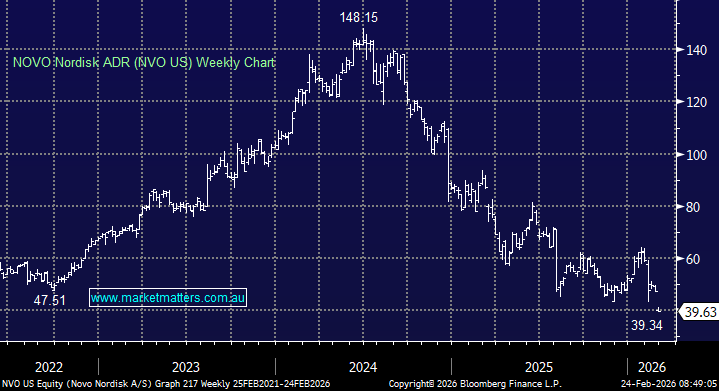
Novo Nordisk shares were smashed overnight, falling more than 16% to their lowest level since 2021, after its next-generation obesity drug CagriSema disappointed in head-to-head comparisons with Zepbound from Eli Lilly. This was an awful outcome for NVO, and the market reacted accordingly, as big questions are being asked, around the company that brought us Ozempic, being able to maintain its leadership in the obesity field. The weakness rippled across the European GLP-1 complex, with Zealand, Bachem and Ypsomed all sharply lower, while Eli Lilly rallied around 5% in US trade, a clear signal that investors increasingly view Lilly’s leadership position as further entrenched.
The sell-off was understandable, with consensus forecasts having assumed strong CagriSema-driven acceleration from 2027, particularly via a successful US launch; those numbers now appear optimistic at best. The conclusive trial results extend Lilly’s advantage and increase pressure for M&A, with Novo’s next major GLP-1/Amylin candidate not due until 2029–30! Downgrades have commenced in earnest with Deutsche catching our eye, slashing its PT by more than 30%.
This is more than just a bad trial result; it reshapes the competitive narrative. Novo still dominates today’s GLP-1 revenues, but the market was paying for future leadership, not the status quo. With Lilly’s advantage now clearer and Novo’s pipeline timeline stretched, we are now reassessing how much terminal value deserves to be capitalised. Near-term volatility is likely to remain elevated, with M&A speculation now firmly back in focus.
- We are reconsidering our recently acquired position in NVO, but M&A could offer real support – MM is long NVO in our International equities Portfolio.