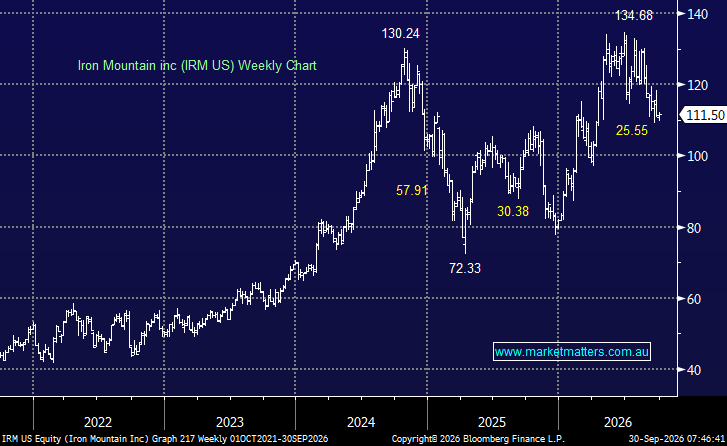
The closest US comparison to Goodman Group’s (GMG) evolution from industrial property into AI and data-centre infrastructure is arguably Iron Mountain (IRM US). IRM started life as a traditional physical-storage business before progressively recycling capital into higher-growth digital infrastructure and now operates more than 100 DC’s globally. The transformation has been rewarded by investors, with IRM up ~37% YTD, while its forward P/E of ~44x illustrates the premium the market is prepared to pay for visible data-centre growth compared with traditional property earnings.
- Iron Mountain doesn’t disclose a directly comparable development yield, although its data-centre EBITDA margin of 52.2% and 10–15-year hyperscaler leases highlight the strong economics available once facilities are operational and stabilised.
Iron Mountain (IRM) is effectively 7–8 years ahead of Goodman in its data-centre evolution, with IRM already a mature operator generating meaningful revenue and earnings, while GMG remains primarily a developer with much of its earnings still to come. However, GMG’s 6.4GW potential capacity dwarfs IRM’s 1.37GW, suggesting Goodman could ultimately become the larger operator—the key difference is timing. Ironically, GMG is being derated because higher bond yields are reducing the present value of those long-dated earnings, while IRM is already beginning to harvest the earnings from investments made years earlier.
The main story for IRM has been the longer-term re-rating: from its early-2022 low around US$42, it more than tripled to its June 2026 peak as investors increasingly viewed the business as digital infrastructure rather than simply a traditional storage REIT.
The transformation has been backed by strong execution:
- Data centres: potential capacity has grown to 1.37GW, with the operating portfolio 97% leased and data-centre revenue growing strongly.
- New growth engines: its IT asset-management business has expanded rapidly, alongside continued growth from the highly recurring legacy storage operation.
- Earnings delivery: IRM has consistently beaten expectations and raised FY26 guidance twice, with revenue and EBITDA on track to grow roughly 31% and 36% respectively from FY24 levels.
The recent pullback looks more like a valuation reset amid surging long-term bond yields than a deterioration in the underlying business. IRM has given back its two-year share-price gains, but earnings continue to grow strongly as valuation pressure weigh on it like other long-duration data-centre exposures.
- We like the risk/reward towards IRM after its ~20% correction but it will require calm to return to bond markets to retest the US$130-140 area.