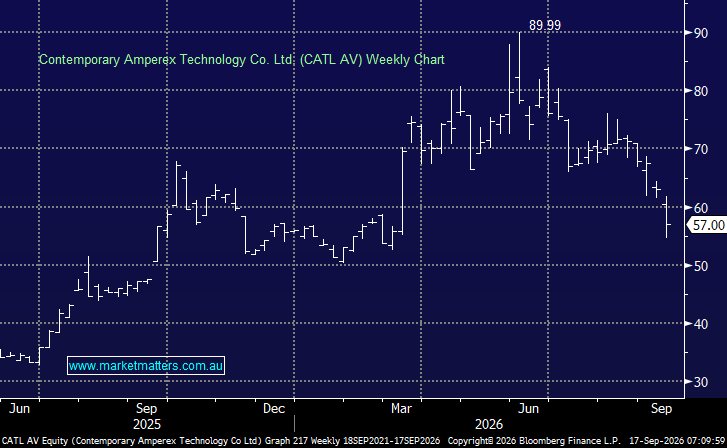
Contemporary Amperex Technology Co. Ltd. (CATL) is the world’s largest EV battery manufacturer and a major player in the lithium supply chain. It is principally listed in Shenzhen (300750 CH) and Hong Kong (3750 HK), with its shares also traded in Vienna (CATL AV). CATL supplies many of the world’s largest automakers, including BMW, Mercedes-Benz and Volkswagen, while Tesla also uses CATL batteries in a number of models.
As mentioned earlier, CATL’s Australian chairman John Kwon expects sodium-ion batteries to approach cost parity with lithium-ion by early 2027. The technology is particularly attractive for stationary energy storage, including potentially data centres, where sodium’s abundance, temperature performance and long cycle life can outweigh its lower energy density. CATL has already signed a three-year, 60GWh sodium-ion storage agreement with HyperStrong in China and expects international deliveries to begin in June 2027.
For lithium producers, sodium-ion represents a longer-term demand threat rather than an immediate shock. Widespread adoption could allow sodium to capture a meaningful share of stationary energy-storage growth, reducing an increasingly important source of future lithium demand.
A quick science lesson for members who cannot remember high-school chemistry: lithium and sodium sit in the same column of the periodic table — Group 1, the alkali metals — and share similar chemical properties. Both readily form positively charged ions, allowing them to perform a similar role within rechargeable batteries.
Why sodium can substitute: Sodium ions (Na⁺) perform broadly the same role as lithium ions (Li⁺), moving between electrodes as the battery charges and discharges. Sodium-ion batteries therefore use broadly similar architecture to lithium-ion batteries — electrodes, electrolyte and separator — although the underlying materials and chemistry differ.
The trade-off is energy density. Sodium ions are larger and heavier than lithium ions, meaning sodium-ion batteries generally require more weight and volume to store the same amount of energy. This leaves lithium-ion better suited to applications where size and weight are critical, particularly longer-range EVs, phones and laptops.
However, sodium is abundant, widely available and potentially offers lower material costs while reducing reliance on geographically concentrated lithium supply chains. This makes sodium-ion particularly compelling for grid-scale, home and data-centre energy storage, where weight matters far less than cost, durability and supply security.
The science and economics are becoming increasingly compelling, and we can see sodium-ion taking meaningful share from lithium-ion in the fast-growing stationary-storage market.
CATL itself has endured a difficult period, with its Shenzhen-listed shares down around 35% from their early-May peak. Concerns that Chinese EV manufacturers are diversifying their battery suppliers have weighed on sentiment, although CATL remains the dominant player in China’s EV battery market.