China’s factory activity slumped last week, marking its longest contraction streak in more than nine years and prompting renewed calls for stronger policy support — even as Beijing reached a trade truce with the U.S. New orders fell at their fastest pace since 2023, reflecting the impact of trade barriers and weak domestic sentiment. While the Trump–Xi agreement to reduce tariffs on Chinese-made goods may offer some relief for manufacturers, subdued local demand and lingering uncertainty in U.S.–China relations continue to cloud the outlook. Friday’s data served as a reminder that further policy stimulus will likely be needed to stabilise growth.
- The performance of iron ore has been particularly impressive trading close to $US110/MT, even as the largest consumer of the bulk commodity struggles to reignite its economy, and a meaningful uptick in supply looms.
Some Chinese exporters told Bloomberg News they were cautiously optimistic that the new trade deal will lift overseas orders, though the excitement that once accompanied such developments has clearly faded. Previous hard lessons from Trump’s earlier trade brinkmanship has led to the need to diversify beyond the U.S., the world’s largest consumer market. With net exports contributing nearly a third of China’s growth this year, their success in finding new customers elsewhere has been instrumental in keeping the economy on track to meet its annual expansion target of around 5%.
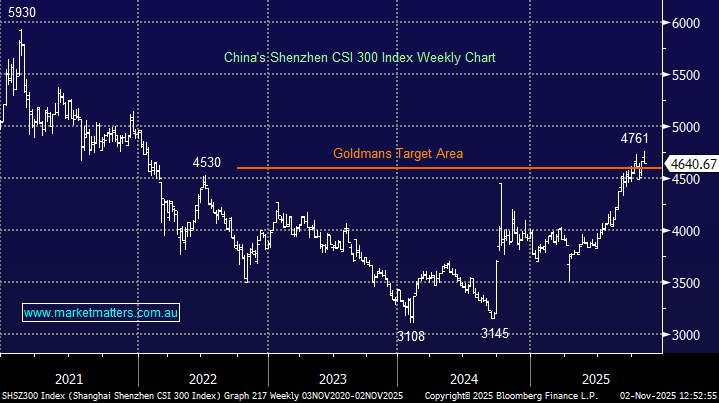
- We can see further rotation by China’s Shenzhen CSI 300 Index around the 4500 area.