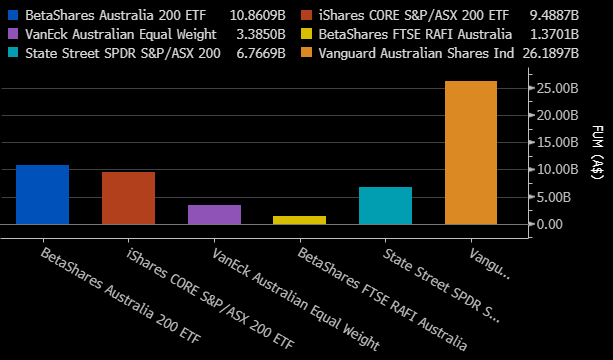
The scale of passive capital tied to the Australian sharemarket has become increasingly important. The six major broad-market ASX ETFs, the VAS, A200, IOZ, STW, MVW and QOZ, now hold around A$58bn between them, with the four traditional market-cap-weighted funds accounting for roughly A$53bn. Vanguard’s VAS dominates at A$26.2bn, more than twice the size of its nearest competitor, while A200, IOZ and STW collectively manage another ~A$27bn. Importantly, these figures capture only listed ETFs; they exclude the much larger pool of passive money sitting in superannuation mandates, unlisted index funds and separately managed portfolios.
As we said earlier this matters because of the concentration of the Australian market. Financials represent roughly 30% of the ASX 200, implying around A$15–16bn of financial-sector exposure across the four major market-cap ETFs alone. Every new dollar flowing into these funds is allocated according to index weight, meaning the largest banks automatically receive a significant share of passive inflows regardless of their valuation or earnings outlook. Conversely, when money leaves these products, those same heavyweight stocks can face mechanical selling.
The bigger story is how quickly this pool of capital is growing. Australia’s ETF industry has expanded dramatically, rising from around A$299bn in August 2025 toward A$500bn by mid-2026 as retail adoption and institutional flows accelerated. While not all of that money is invested in Australian equities, and industry-wide ETF AUM should therefore not be confused with ASX 200 passive exposure, the direction is clear: passive capital is becoming an increasingly powerful force in the local market.
- On an index as concentrated as the ASX it’s an important consideration. Flows into broad-market ETFs can reinforce leadership among the largest stocks on the way up, while a reversal in flows can amplify rotations away from them on the way down.
As a point of note, our market is dwarfed by the US, where this week the Vanguard S&P 500 ETF (VOO US) received $14.6 billion of new capital, pushing FUM to ~US$1 trillion.