A subscriber emailed in over the weekend and made a very good observation following Storage King’s result: rates rise, interest costs rise, and leveraged property vehicles feel the impact with a lag. That sounds obvious, but it is becoming increasingly important as we work through FY26 reporting season.
Three results in the space of a week – Abacus Storage King (ASK), Charter Hall Long WALE REIT (CLW) and HomeCo Daily Needs REIT (HDN), have all told a very similar story. Their underlying property portfolios are generally holding up reasonably well, but higher funding costs are now flowing through to earnings and distributions.
It raises an important question: after significant falls across many property stocks over the past year, are we still too early owning/buying the sector?
Our answer is: possibly early on earnings, but not necessarily early on valuation.
The interest-rate pain is still coming through, which was obvious in the three above mentioned results. Property companies tend to feel higher interest rates with a delay because debt is generally hedged for several years. When rates first rise, existing low-cost hedges protect earnings. Over time, however, those hedges expire and have to be replaced at prevailing market rates.
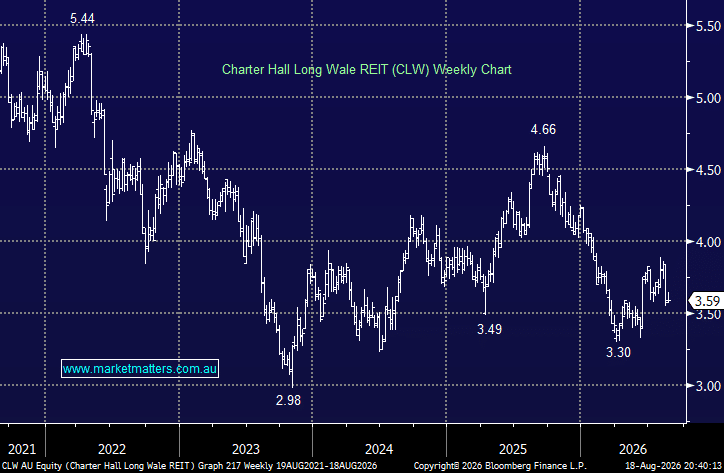
At Charter Hall Long WALE REIT (CLW), which we own in the Income Portfolio (bought at $3.55 in May this year), FY26 operating EPS increased 2.4% to 25.5c and the portfolio remains fundamentally strong, with 99.9% occupancy, a 9.2-year WALE and rental increases around 3%. Yet, FY27 EPS guidance is essentially flat. That is disappointing given CLW has increased its hedge ratio to around 85% and sold A$245 million of assets at yields below 5%, using the proceeds to repay debt costing closer to 6%. Those actions should be accretive, but higher underlying funding costs are absorbing much of the benefit.
Storage King Group (SKG) provided an even clearer example. The operating business remains relatively resilient, but FY27 distribution guidance of just 4.5c was well below expectations. The culprit is largely the reset from historically cheap hedging toward current market funding costs.
Similarly, HomeCo Daily Needs REIT (HDN) guided to FY27 FFO of 8.8c per unit, around 2% below FY26. Its average cost of debt has risen to around 5%, while gearing sits at 35.7%.
The message across all three is consistent: the assets are generally performing better than the earnings given the burden of higher funding costs.
So, why doesn’t this necessarily mean we should avoid the sector?
The temptation is to wait until interest costs have fully reset and earnings growth has resumed. The problem with that approach is the share prices may have already moved well before the earnings inflection becomes obvious. Property stocks have already been heavily de-rated as investors anticipated higher interest rates, falling asset values and weaker earnings. In some cases, securities now trade at substantial discounts to underlying asset values.
SKG, for example, trades at around a 29% discount to NTA, while HDN has received A$400–500 million of unsolicited offers for assets at or above book value. If external buyers are willing to pay around book value for individual properties while the listed vehicle trades at a substantial discount, it suggests the market may already be pricing in a fairly pessimistic outcome.
There is also an important distinction between asset values and earnings. Capitalisation rates have already expanded materially across many parts of the property market, pushing valuations lower. If bond yields and interest rates stabilise from here, even without falling aggressively, the pressure on cap rates may begin to ease. At the same time, inflation linked rents continue to increase across many portfolios. That means the ingredients for a recovery can start falling into place even while reported funds from operations (FFO) remains under pressure.
However, and most importantly, balance sheets matter more than ever in this type of environment. Put simply, we don’t think this is an environment where investors should simply buy the property sector because it has fallen.
The winners are likely to be those with:
- Conservative gearing.
- Long-dated and appropriately priced debt hedging.
- Strong tenants and high occupancy.
- Rental growth that can offset funding costs.
- Assets that can be sold around book value if required.
- Capacity to fund development without raising dilutive equity.
This reporting season has reinforced that two REITs with similar-looking property portfolios can produce very different earnings outcomes depending on how their balance sheets are structured. The hedge book is almost as important as the property book at the moment.
So, are we too early?
Perhaps a little. FY27 is increasingly looking like a reset year for parts of the property sector, as old low-cost debt rolls into a higher-rate environment. That means earnings and distributions may remain under pressure even if the underlying properties continue to perform reasonably well. But markets are forward-looking, and by the time funding costs have fully normalised, rates have peaked, earnings are growing again and management teams are confidently upgrading guidance, the better property stocks are unlikely to still be trading at today’s discounts.
Boiling all of this down, we think the current environment calls for selective accumulation rather than a wholesale bet on property. There is still earnings pain to work through, and SKG, CLW and HDN all reinforced that point last week. However, falling share prices, discounts to asset values, resilient rents and evidence of private-market demand for assets are creating opportunities. We may be early on the earnings recovery, but that is often when the better investment opportunities emerge.
The key is owning the right balance sheets and being prepared to look through a difficult FY27 toward a more normalised earnings environment beyond it. At this stage, we own Charter Hall Long WALE REIT (CLW) and Mirvac (MGR) in the Income Portfolio (and also hold MGR in the Growth Portfolio). The positions are around our entry levels (+/- 5%) and they have not performed as well as we had hoped, having bought in March (MGR) and May (CLW) of this year.
For now, we have a foot in the door of the sector, but we’re unlikely to add to these positions until we get clear evidence that interest rates/bond yields have peaked; that will almost certainly take a lasting resolution from the Middle East, and ongoing improvement in inflation. Importantly though, we do think that buying into property will ultimately need to be done before all positive indicators are in place. *NB – Mirvac reports this morning.