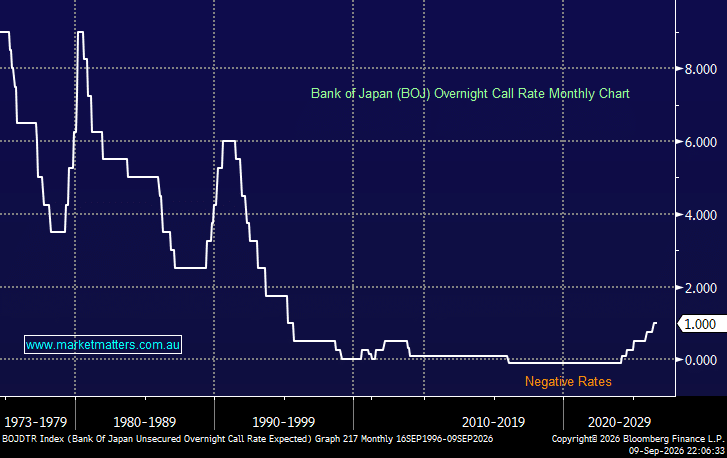
As we mentioned, the most recent significant carry trade unwind hit the ASX 200 just over two years ago, triggered by the Bank of Japan’s surprise rate hike on 31 July 2024, its second hike of the year, which caused a rapid yen appreciation and forced leveraged carry positions to be unwound in almost panic-like fashion across the entire global financial system.
- The ASX 200 dropped by 6.4% in an aggressive 2-week sell-off before recovering over the following 3 weeks.
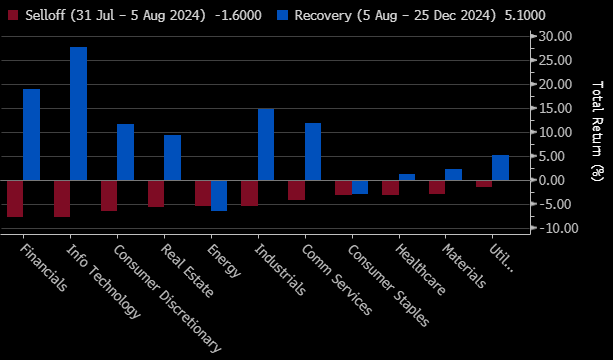
At the granular level, the pattern in 2024 was a classic carry-trade unwind followed by a sharp reversal: the sectors hit hardest by the initial liquidity shock, particularly Technology and Financials, rebounded the most as conditions stabilised. Conversely, the more defensive areas that weathered the sell-off relatively well generally lagged the recovery, while Energy (-6.5%) and Consumer Staples (-3.1%) were the only sectors still underwater by Christmas. Obviously, there are far more factors at play this time around, but the appreciation of the Yen is likely to be influencing the ASX, albeit not as obviously as rising bond yields:
- If we see a repeat performance in 2026, the banks and tech sector should regain their mojo when least expected.
In 2024, Information Technology (+27.7%) delivered by far the strongest recovery, despite being among the hardest hit during the initial sell-off (-7.7%), as falling global rate expectations triggered a sharp re-rating of growth stocks into year-end. Financials (+19.0%) followed a similar path, rebounding from the largest initial decline (-7.8%) as improving margin expectations and strong earnings momentum attracted buyers, while Industrials (+14.7%) and Communication Services (+11.9%) also recovered strongly. Rate-sensitive Real Estate (+9.4%) and Utilities (+5.1%) benefited from the emerging rate-cut narrative, while Materials (+2.2%) and Healthcare (+1.1%) lagged.
The current Yen Carry Trade unwind is far more subtle than in 2024, but it is adding a similar spice to markets as rising bond yields, which is also weighing on the ASX without the steroids of 2022 i.e. the stocks and sector movement during the falls and recoveries in 2022 and 2024 were almost carbon copies of each other.

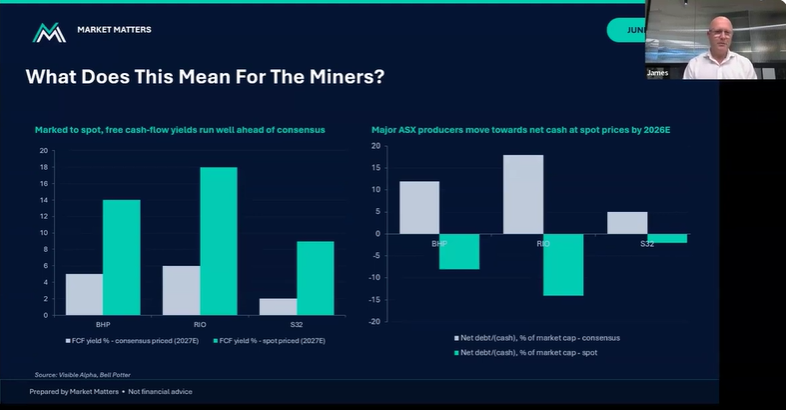
On the stock front the most vulnerable ASX stocks are high-multiple, long-duration growth names, four of which are held in the MM Growth Portfolio, WiseTech (WTC), Xero (XRO), Pro Medicus (PME) and Goodman Group (GMG). Resources and Energy, including BHP, RIO, FMG, WDS and STO, could and currently are proving relatively defensive, with a stronger yen improving Japanese purchasing power for US-dollar-denominated commodities and LNG, although we do largely have a US-Iran war to thank for strength in the energy sector.
The market is set to open this morning down ~5% from its August all-time high, but as members know, while we remain bullish into Christmas, we have no plans to increase risk over the current days. Standout casualties from the Yen Carry Trade sharp unwind in 2024 bear a strong resemblance to recent days:
- WiseTech Global (WTC) -12.0%, Qantas Airways (QAN) -11.2%, National Australia Bank (NAB) -10.5%, IGO (IGO) -10.1%, Commonwealth Bank (CBA) -9.9%, BlueScope Steel (BSL) -9.9%, Suncorp Group (SUN) -9.7%, and Pro Medicus (PME) -9.7%.
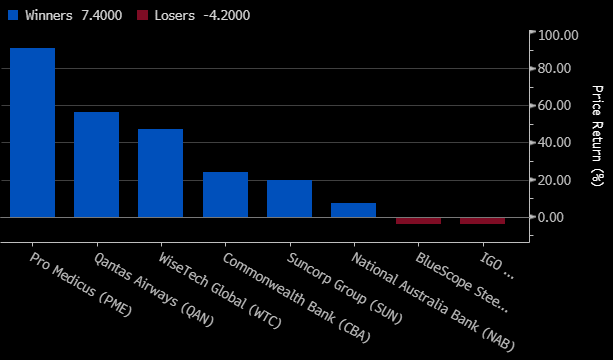
The software names were the ones in this case that subsequently bounced back the hardest into Christmas:
- Pro Medicus (PME) +91.2%, Qantas Airways (QAN) +56.4%, WiseTech Global (WTC) +47.2%, Commonwealth Bank (CBA) +24.2%, Suncorp Group (SUN) +19.6%, National Australia Bank (NAB) +7.4%, BlueScope Steel (BSL) -4.0%, IGO (IGO) -4.2%.
It’s important not to expect markets to rhyme on demand, but as we’re already seeing this September, history can be useful. In this case, when we combine how the ASX reacted during the bond tantrum of 2022 and the carry trade unwind of 2024, we come to two conclusions which reinforce our general analysis moving through 2026:
- Firstly, the banks can still fall further, as we saw with CBA yesterday; its decline is accelerating as opposed to finding support = buyers need to be patient here.
- Secondly, a snapback by the software-facing stocks could be dramatic, but more weakness feels likely in the coming weeks.
When we choose to increase risk moving forward, we will be weighing up tech and banks against resources and utilities, which outperformed in the last quarter of 2022:
- However, overall it’s important to remember that at MM we adopt a top-down meets bottom-up approach; hence our final actions will very much be driven by our views on individual companies.