We discussed TCL in detail here; our conclusion at the time was “MM is positive on Transurban as a long-term income investment, but we would prefer to accumulate during periods of weakness.” Yesterday, the stock retreated almost ~2% after the CPI, taking it more than 6% below where it was when we wrote the previous piece, posing the question: is it time to start accumulating?
So far in October, TCL has risen ~5%, supported by solid traffic growth and progress on major infrastructure projects.
- The company agreed to acquire CPPIB’s stakes in NorthWestern Roads Group and Sydney Transport Partners for $4.5 billion, increasing its exposure to WestConnex, NorthConnex and Westlink M7.
- The Q1 FY27 traffic update provided a further boost, with average daily trips rising 3.1% year-on-year to almost 2.6 million, led by North America (+4.7%) and Melbourne (+4.2%).
Transurban also reached commercial close on Nashville’s I-24 Choice Lanes project, a major milestone in its US expansion. However. the stock is currently balanced between strong operating momentum and concerns about funding and distribution growth. Overall, the October share-price gain reflects some confidence in Transurban’s long-term toll-road portfolio and growth pipeline, although the benefits of the Sydney acquisition will need to outweigh its near-term financing costs.
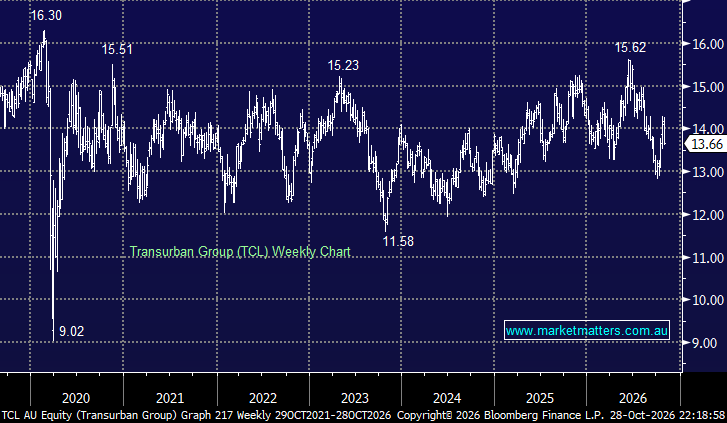
Transurban is relatively insulated from short-term rate moves but sensitive to refinancing risk as hedges roll off and debt is refinanced at prevailing market rates — a dynamic that is expected to add ~$50M to net finance costs in FY2027, which reduces free cash flow. TCLs dividend policy is to pay out between 95-105% of free cash flow; therefore, higher funding costs weigh on dividends, making TCL an interest rate sensitive name. The offset here is their ability to increase traffic and increase prices, reducing the impost. The 5-year chart below shows these competing forces at play, keeping TCL fairly range bound.
- We cannot discount TCL testing back towards $12, or ~10% lower if the market gets fixated on rate hikes – the risk/reward still isn’t enticing.
MM is cautiously bullish towards TCL around $13.50
Add To Hit List