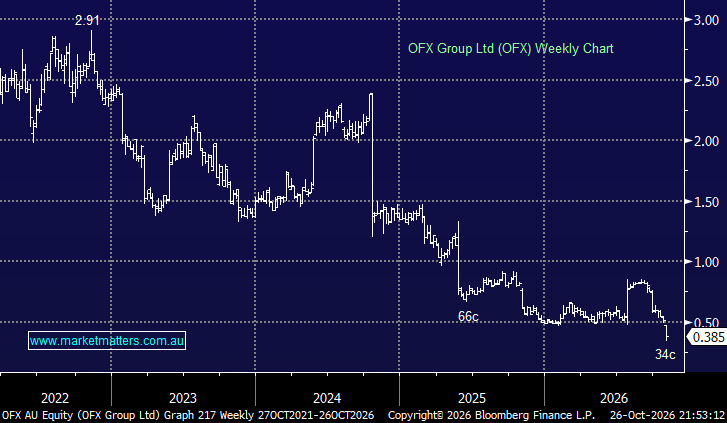
OFX Group (ASX: OFX) is a ~$90mn global online international payments business, essentially a lower-cost alternative to traditional banks for cross-border money transfers and FX transactions for individuals and businesses. It was a market darling for a while, but the sector has become far more competitive, with larger, well-funded players entering the mix, including Wise (NASDAQ: WSE), a ~US$13bn business with a better platform, deeper pockets and a much stronger growth trajectory.
Scale is important in this space, and OFX had been subject to a takeover proposal from Alakazam Holdings Bidco, the entity behind UK-based international payments firm Equals Group. The proposed acquisition of all issued OFX shares at $1.00 per share had provided support for the stock, but the deal has now fallen over, with OFX being smacked ~25% on Monday, compounding an already awful year for shareholders.
The collapse of the takeover comes amid already weak investor sentiment following OFX’s 1 October disclosure of a cybersecurity incident involving unauthorised access to some client data. The company said no client funds had been accessed and no financial losses to clients had been identified, while its systems continued to operate normally. However, it’s clearly a major issue and raises questions about the robustness of its cybersecurity framework.
Operationally, OFX delivered its weakest half on record in 2H26, with revenue down 11.8% year-on-year and EBITDA falling 62.7%, resulting in a statutory net loss. While the company has a reasonable cash buffer, with ~$50mn in net cash available, it’s the deteriorating earnings trajectory that concerns us most.
In FY26, OFX generated $25.8mn in free cash flow, down from $71.3mn in FY25. EBITDA has declined from $64.6mn in FY24 to just $25.2mn in FY26, as revenue softened across both Corporate and Consumer, while costs have proved difficult to reduce at the same pace.
- We remain concerned about OFX’s lack of scale, intensifying competition and declining earnings. While cash on hand represents a significant portion of its market capitalisation, that’s not enough to get us interested.
MM is neutral at best towards OFX
Add To Hit List