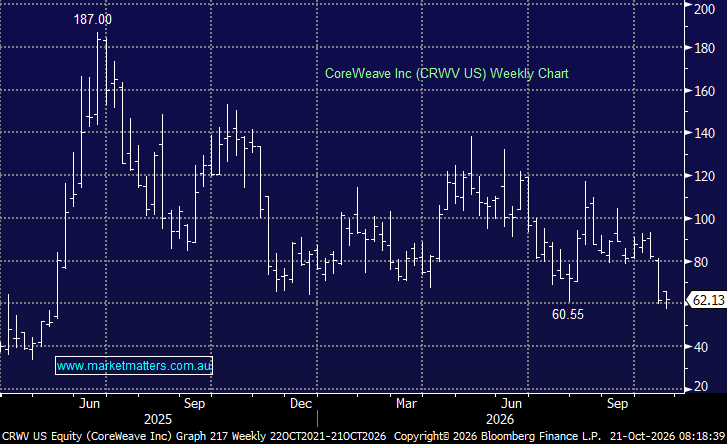
CoreWeave (CRWV) has become the poster child for growing concerns around the enormous amount of debt being used to fund the AI infrastructure boom. The stock has fallen more than 50% from its May highs, while a sharp sell-off in its bonds has raised questions about the sustainability of its business model. Importantly, this weakness has spread across the broader AI infrastructure space, including IREN (IREN US), which we hold in our International Equities Portfolio.
CoreWeave is one of the largest specialist AI cloud infrastructure providers, commonly called neoclouds, essentially buying enormous amounts of NVIDIA’s high-performance chips (GPUs), housing them in data centres and renting that computing power to major technology companies developing AI models. This is the same model run by Firmus, IREN and Nebius. For CRWM, demand has been extraordinary, with 2Q revenue more than doubling to US$2.58bn and its contracted revenue backlog reaching around US$104bn. These trends have no doubt underpinned the massive hype across the sector, but in the last few weeks, cracks have started to form.
Delivering such explosive growth requires enormous upfront investment, largely funded through debt. In CoreWeave’s case, they had ~US$35bn of balance-sheet borrowings at the end of June, with planned capital expenditure of around US$39bn in 2026. While quarterly adjusted EBITDA reached US$1.51bn, the company still reported a US$626m net loss, with net interest expense alone running at ~US$640m for the quarter.
This is where the market is becoming increasingly nervous. Yields on some CoreWeave bonds have moved from around 9.7% when issued to above 16%, effectively distressed-debt territory. The concern isn’t necessarily a lack of demand for AI computing power, but whether the returns generated from these expensive assets will justify the amount of capital required to build and finance them.
This is amplified by the speed at which GPU development is taking place, which puts a question mark around the useful life of GPUs. NVIDIA continues to release more powerful chips, creating the risk that today’s expensive hardware depreciates faster than anticipated. Add higher borrowing costs and potential construction delays, and the economics can change quickly, even with customers contracted.
What does this mean for IREN? There are similarities, but also some important differences. IREN has leveraged its existing power infrastructure and data centre sites to expand rapidly into AI cloud services, securing US$4bn of contracted annualised recurring revenue (ARR), although only around US$1bn was operating at its latest update. The challenge now is delivering the capacity and converting those contracts into actual earnings and cash flow.
Importantly, IREN has secured project-specific financing, including a US$3.6bn facility supporting its Microsoft contract at approximately 6%, alongside customer prepayments that cover the bulk of the associated GPU investment. More recent financing has been struck at around 9%, highlighting that the cost of capital is rising across the sector, although IREN’s funding arrangements differ from CoreWeave’s more heavily leveraged structure.
We think the market is increasingly distinguishing between companies announcing large AI contracts and those capable of delivering them profitably. In the early stages of the AI boom, investors rewarded growth almost regardless of cost. That is changing, with greater scrutiny of debt levels, financing costs, depreciation and, ultimately, free cash flow.
We don’t own CoreWeave, but we do hold IREN, and the recent weakness across the sector has knocked IREN ~30% below our purchase price. While we believe CoreWeave’s financing concerns are legitimate, we wouldn’t extrapolate its problems across every AI infrastructure provider. Demand for computing capacity remains strong, but the market is becoming far more selective about how that growth is funded.
For IREN, the investment thesis remains intact in our view, with substantial contracted revenue, valuable power infrastructure and financing in place to support its expansion. However, execution is now critical, and the company needs to demonstrate that these contracts can translate into attractive returns and sustainable cash generation.
We have no interest in CRWV given it’s aggressive funding structure, but we do remains positive on IREN over the medium term, though recognise is high volaitlity, hence our ~3% portfolio target weighting, which is now closer to a 2% prevailing weight. The AI infrastructure opportunity remains significant, but the days of the market rewarding growth at almost any cost are over in our view.
MM prefers IREN to CRWV at current levels
Add To Hit List