Harvey Norman (HVN) sits squarely in the firing line of the reverse wealth effect, with its fortunes closely tied to both big-ticket consumer spending and the health of the housing market, and its performance reflects this, with the stock having fallen almost 40% so far in 2026, just piping Nick Scali to be the worst performer of the major retailers.
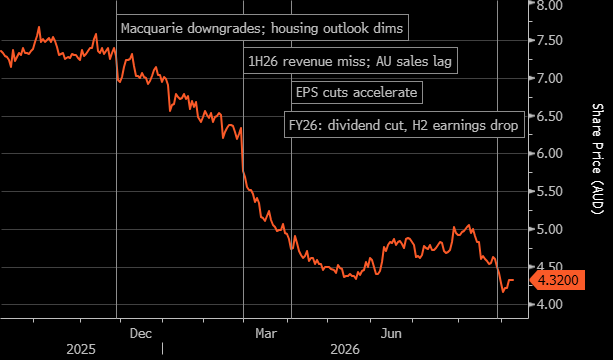
HVN’s decline has primarily been a de-rating story, with its forward P/E compressing from around 18.9x to 12.7x, a 33% contraction that explains much of the share-price weakness. Initially, earnings weren’t the problem—EPS expectations actually increased through late 2025, but the backdrop deteriorated as the housing downturn and weaker consumer confidence started building. A Macquarie downgrade in November was followed by a disappointing 1H26 revenue result in February, before earnings downgrades accelerated from April. The August FY26 result compounded the pressure, with weaker Australian sales, a softer second half and a dividend cut reinforcing concerns around the earnings outlook.
- When confidence does return around the Australian consumer, much of this valuation derating can be reversed rapidly.
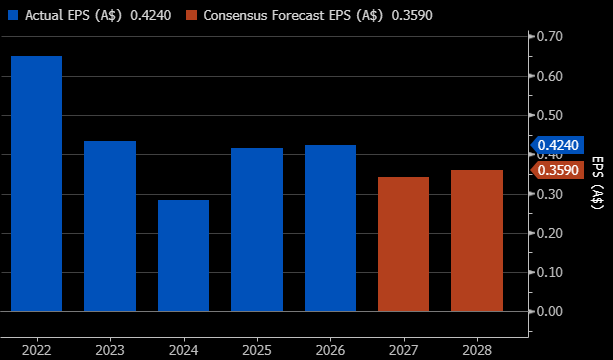
HVN now faces the more difficult combination of multiple compression and falling earnings expectations. Exposure to furniture, appliances and electronics leaves it firmly in the firing line of the reverse wealth effect, as falling house prices, softer housing turnover and elevated mortgage costs encourage households to defer big-ticket purchases. Consensus now expects EPS to fall around 19% to A$0.343 in FY27, before only a modest recovery in FY28, leaving HVN on roughly 12.6x forward earnings at $4.32.
- In simple terms, at the moment the market is not only prepared to pay less for each dollar of HVN earnings, but it now expects fewer earnings dollars as well.
chart

Harvey Norman Ltd (HVN) Annual EPS: Source – Bloomberg
chart
Harvey Norman Ltd (HVN) Annual EPS: Source – Bloomberg
HVN is slowly gaining strength after its savage derating, bouncing ~5% from its weakness following its mixed FY26 result, covered here. The issue last month was soft trading in July, and a pick-up in housing activity is the data point that we will be watching to infer that HVN can turn the corner – the headlines are poor on this front, but as we know, markets bottom when things look their worst. It’s important to remember this is a solid business whose stock is forecast to yield ~6% fully franked, and when some degree of confidence returns to the sector it could easily recover ~20-30%, paying a nice dividend along the way.
At this stage were not prepared to don a contrarian hat, but we are questioning if perception can get much worse on the consumer front with RBA rate hikes and a deteriorating property market built into prices.
- We can see attractive risk/reward for HVN if it tests the psychological $4 area, 6-8% lower.
MM is neutral towards HVN around $4.30
Add To Hit List
chart
Harvey Norman Ltd (HVN): Source – Bloomberg
chart
Harvey Norman Ltd (HVN): Source – Bloomberg