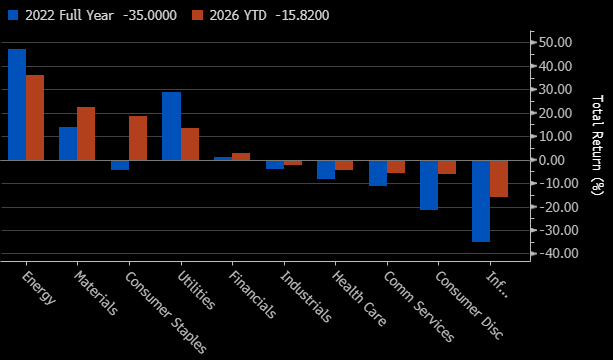
The current ASX sector performance in 2026 is already bearing a strong correlation to 2022, perhaps we’re going to see a carbon copy minus the steroids:
- Energy leads both years: the top performer in 2022 (+47.0%) and again in 2026 YTD (+35.9%), driven by elevated oil prices.
- Information Technology is the worst performer in both: -35.0% in 2022 vs -15.8% YTD in 2026, reflecting rate sensitivity although the AI Disruption Trade has played a major role this year.
- Materials and Utilities are strong in both periods, benefiting from commodity tailwinds and defensive positioning
- Consumer Discretionary and Communication Services are laggards in both years, consistent with a rate-tightening environment squeezing consumers and growth valuations
The standout difference is Consumer Staples, which fell -4.4% in 2022 but is up +18.5% YTD in 2026, highlighting a much stronger rotation toward defensive sectors this time around.
- Sector moves in 2026 have been roughly half the magnitude of those seen in 2022, reinforcing our view that we’re not set to experience a full blown “bond tantrum.”
The pattern is remarkably similar across both periods, with commodity-linked sectors outperforming while rate-sensitive growth stocks lag, again reinforcing our view that the current market dynamic is shaping up as a milder replay of the 2022 rate shock – something we can work with to add value into Christmas.

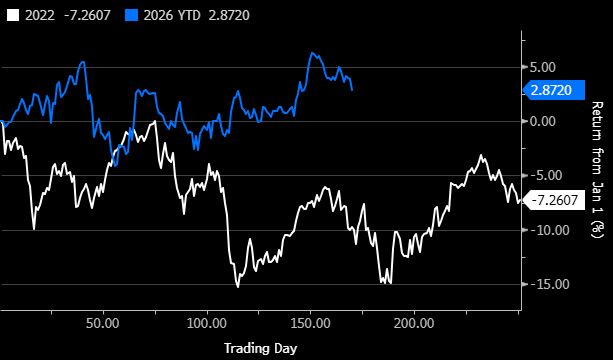
The chart below compares the ASX 200 in 2022 and 2026 with both years indexed to 0 from the first trading day to provide a clean comparison, and the contrast is noticeable.
- 2022 was characterised by a persistent risk-off trend, with the ASX 200 falling ~15% by mid-year as the RBA aggressively tightened rates to combat inflation, before recovering some ground to finish ~7% lower.
- 2026 has been far more resilient: after falling ~4% through March, the market rallied to around +6% in early August and remains ~3% higher YTD despite the recent pullback.
While both periods experienced meaningful bouts of weakness, the magnitude and market behaviour are very different. Dip-buyers have consistently emerged in 2026, whereas 2022 was dominated by sustained selling until the 4Q recovery — reinforcing our view that, so far, the current rate-driven correction remains a much milder version of 2022.
- If we see another sell-off this month we again believe dip buyers will emerge, the key being from where.