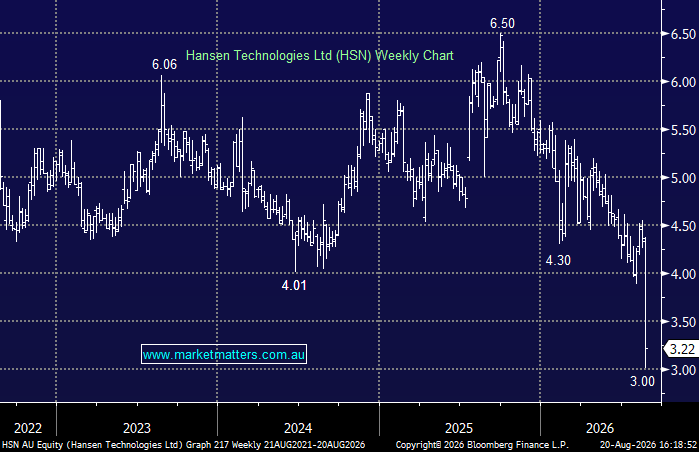
HSN -3.88: Reported a mixed FY26 result yesterday, with guidance that was ~10% below consensus + they announced long standing CEO Andrew Hanson was stepping down as CEO.
Key FY26 numbers:
- Revenue of A$386.5 million, around 4% below the A$403.6 million expected.
- EBITDA of A$119.6 million, broadly in line with the A$120.6 million expected.
- EBIT of A$69.9 million, around 10% below the A$77.7 million expected.
- Adjusted NPAT of A$65.9 million, around 12% ahead of the A$58.8 million expected.
- Statutory NPAT of A$47.8 million, broadly in line.
- Free cash flow of A$95.3 million, comfortably ahead of the A$79.2 million expected.
- Final/full-year dividend of 10c per share, broadly in line with expectations.
While the shares were hit yesterday (and again today), the result was better underneath than the headline revenue miss suggests. Support & Maintenance revenue grew around 14% year-on-year, or approximately 7% organically excluding acquisitions and FX, while Hansen removed around A$20 million from its operating cost base. That helped underlying EBITDA margins reach around 31%, while gross free cash flow was a record for the group.
The issue is FY27. Management expects broadly stable revenue, with Support & Maintenance growing 6–8%, but licence revenue falling from roughly A$35 million to around A$20 million as more contracts shift from upfront licence fees into recurring revenue. Importantly, this is more a change in revenue recognition and contract structure than a deterioration in customer demand.
At the same time, Hansen plans to invest A$14–18 million across AI and sales & marketing, which will weigh on near-term margins. FY27 underlying EBITDA margin guidance is above 26%, down from around 31% in FY26, before management expects revenue growth to resume and margins to recover to 30%+ in FY28.
That investment has forced material earnings downgrades. For instance, Shaw cut its FY27 EBITDA forecast by 22% and NPAT by 40%, although the reductions moderate significantly in FY28 and FY29 as the benefits of the investment are expected to come through.
There is also an interesting management change. Stuart MacDonald, formerly COO of TechnologyOne, will become CEO in November, while Andrew Hansen moves to Executive Chair and retains responsibility for strategy and M&A. Given MacDonald’s experience through TechnologyOne’s SaaS transition and increasingly sales-led growth model, his appointment looks highly relevant to what Hansen is trying to achieve.
MM’s view: FY27 is shaping up as a reset year, and the earnings downgrades are significant enough that we wouldn’t dismiss them. However, we think there is more going right operationally than the share-price weakness suggests.
The recurring revenue mix is improving, cost control has been strong, cash generation was excellent and the balance sheet is heading towards net cash. If management can successfully reinvest the FY26 cost savings into sales and AI, and deliver on its target of returning margins above 30% in FY28, the current valuation starts to look interesting.
For us, the key is that FY27 looks like a deliberate investment year rather than evidence the underlying business is deteriorating. That makes Hansen one worth watching closely after the recent de-rating.
MM is bullish HSN ~$3.20
Add To Hit List