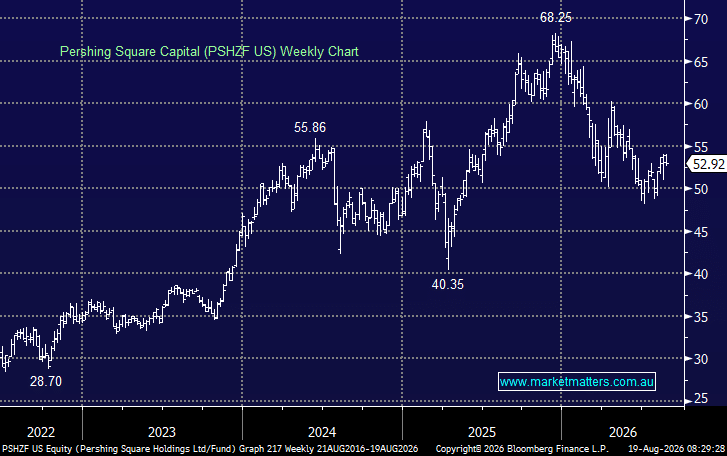
We have held Pershing Square since 2023 from ~US$38.50, with the shares now trading ~US$53, representing a capital gain of ~40%, or around 11% p.a. We’d describe this as an “okay” investment, but the question for us now is whether the original thesis still stacks up.
Pershing gives investors access to Bill Ackman’s concentrated portfolio at a substantial discount to underlying net asset value. That discount was part of the attraction when we bought it, but frustratingly, it has shown little sign of structurally closing.
At the end of July, NAV was US$77.10 per share, while recent buybacks were being completed around US$52.39. That implies a discount of roughly 32%. In other words, investors are still paying only around 68c for every dollar of underlying assets. However, the narrowing of the discount over the past three years hasn’t really played out as we had envisaged, and this remains an issue with the holding.
During our ownership period, Pershing has generally traded at a discount of somewhere around 20–30% to NAV. Today, that discount is at the wider end of the range, but we haven’t seen any tangible evidence that the market is prepared to permanently re-rate the vehicle towards NAV. This means we need to be careful about treating the discount itself as the investment thesis.
A 30% discount can look compelling, but if it simply remains at 30%, shareholders ultimately earn something close to the underlying portfolio return, adjusted for leverage, fees, dividends and buyback accretion. The discount only provides an additional kicker if it narrows, and we haven’t seen that.
Therefore, we need to be very conscious of the performance of the underlying portfolio i.e. what’s happening under the hood. This also has a bearing on prevailing discounts, with strong performance often leading to narrower discounts, or even premiums, thereby amplifying total shareholder returns. Weak performance will generally work in reverse.
To that end, recent performance has been weak. Pershing’s NAV return was -9.2% for the year to 31 July, despite July itself delivering a 3.9% rebound. The portfolio had 15 long positions and gross equity and debt exposure of around 126% of NAV at month-end. Comparing this with our own unlevered International Equities Portfolio, which has returned +16.5% over the same timeframe, and the MSCI World Index in AUD, up 10.4%, Pershing’s recent returns are clearly weak.
Ackman does, however, have a strong long-term track record, delivering returns of around 16.9% p.a. over the past 10 years. The portfolio is concentrated, though, and returns are therefore likely to remain lumpy from year to year. Pershing has made some major changes to the portfolio during 2026, undertaking a significant rotation and adding stocks including Microsoft, Netflix, Visa, Mastercard, S&P Global, Intercontinental Exchange and Alcon, while reducing or exiting Chipotle, Hilton, Alphabet, Universal Music Group, Hertz and Nike.
As it stands now, we think the portfolio is increasingly skewed towards high-quality, cash-generative stocks with strong competitive advantages, rather than situations where the investment thesis requires significant corporate change. Visa and Mastercard are global payments toll roads, S&P Global and ICE own valuable financial infrastructure, while Microsoft provides direct exposure to enterprise AI. Netflix is also an interesting return for Ackman after famously exiting the position in 2022 for a large loss over a relatively short period.
That said, the timing of these changes hasn’t worked yet, with performance still in the doldrums. As we suggested earlier, Pershing’s concentrated approach means individual holdings will have a bigger influence on returns, and this is not a strategy that will track global markets closely over shorter time periods. More recently, the fund also hasn’t been particularly well positioned for some of the strongest areas of the market, such as semiconductors.
However, we still think Ackman has demonstrated an edge over a long period, and buying into a fund when short-term performance has been weak and the discount is wide can certainly make sense. Pershing also continues to buy back its own shares, which is highly accretive when they trade 30% or more below NAV.
For example, in early August it repurchased shares at an average US$52.39 against a reported NAV of US$77.10. Every transaction like this increases NAV per share for remaining shareholders. However, buybacks have been happening for years and have still not materially closed the discount. They improve the economics for holders, but we don’t think they provide a compelling reason on their own to expect the valuation gap to disappear.
So, should we still hold it?
When we purchased Pershing Square in 2023, we saw two potential sources of return:
- Ackman delivering attractive returns from the underlying portfolio; and
- The substantial discount to NAV narrowing over time.
The first has broadly worked over our holding period, with the shares plus dividends increasing by around 40%, but the second part hasn’t. We therefore need to be comfortable with Pershing’s ability to generate solid portfolio returns. On that front, we like the composition of the portfolio and still think Ackman and his team are smart operators.
However, we would no longer assign much value to the prospect of the discount closing. After watching it persist in the 20–30% range throughout much of our ownership, we think it is more sensible to regard a sizeable discount as a structural feature of the vehicle, rather than a temporary anomaly.
Ultimately, we remain comfortable holding Pershing Square, but the reason has changed somewhat. The current 30%+ NAV discount is attractive, but we don’t see a clear catalyst for it to materially close and therefore wouldn’t base the investment case on that occurring. Instead, the key question is whether the underlying portfolio can perform. We think it can, while ongoing buybacks remain very supportive and highly accretive at current discount levels.
MM remains long & positive PSHZF/PSHD ~$53
Add To Hit List