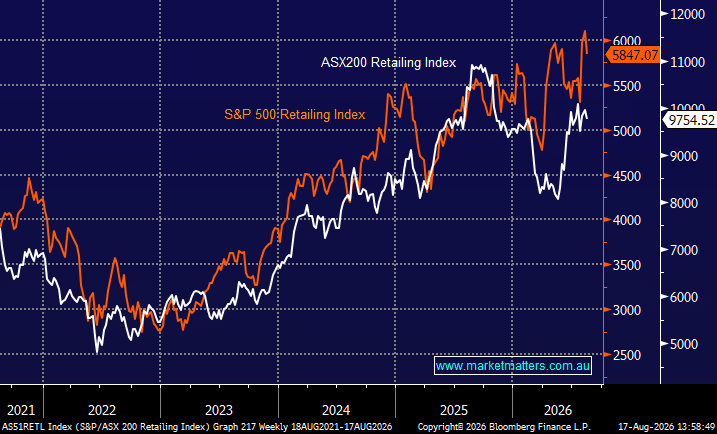
Over the past five years, US Consumer Discretionary stocks have outperformed their Australian counterparts, although the path hasn’t been in straight line. Both were hit hard by the 2022 tightening cycle, with the US initially suffering the deeper drawdown, partly reflecting its heavier exposure to Amazon and Tesla, before leading the recovery through 2023. Australian discretionary then enjoyed a strong relative run through 2024/25, but much of that advantage has since unwound.
That recent performance reversal was on full display Monday, with JB Hi-Fi whacked -12.3% as investors looked through solid FY26 numbers to a sharp deterioration in July trading; same-store sales fell 1.4% at JB Hi-Fi Australia and 1.7% at The Good Guys – the first time that’s happened in 13 years. The sell-off quickly spread across domestic retailers, suggesting the market viewed JBH less as an isolated miss and more as another warning that the Australian consumer is starting to buckle under the weight of higher rates and cost-of-living pressures.
We delved into JBH’s result in detail yesterday here, with the result bringing together two of the most important themes facing the Australian economy:
- The housing slowdown – The key for retailers is not house prices themselves but housing turnover; moving house is when consumers tend to spend on fridges, furniture and appliances. The big banks have already seen mortgage applications plunge by 12-20% since the budget, and this could easily be a period of stagnation for the once revered Australian property market.
- The AI boom – Surging demand for memory chips is pushing up component costs for PCs, phones and other electronics, putting many products beyond a stretched consumer.
A painful combination for a retailer like JBH, with an electronics bias! We consider two questions today: should we hold any retail stocks into Christmas, remembering we believe the RBA won’t hike again this year, and if so, which stock offers the best risk/reward in the current environment, bearing in mind many consumer facing names have already been hammered over the last 6-9 months.
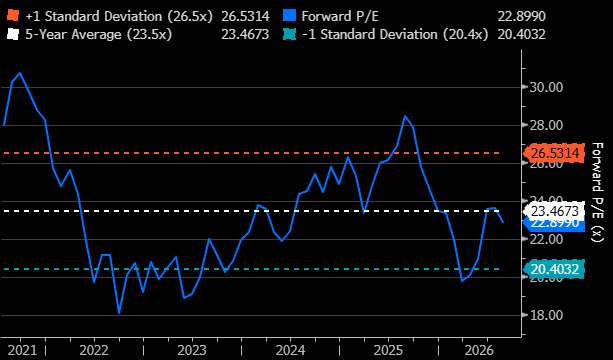
The ASX 200 Consumer Discretionary sector trades on 23.6x forward earnings, only a ~4% discount to its S&P 500 counterpart at 24.7x. That gap looks surprisingly narrow given the very different composition of the two markets, with the US sector carrying substantial exposure to growth-heavyweights such as Amazon and Tesla, while the Australian index is more concentrated and has greater exposure to domestically sensitive consumer businesses.
On headline multiples, ASX Consumer Discretionary looks fairly valued rather than obviously cheap, but arguably in the current environment it’s still rich. If JBH proves to be a canary in the coal mine for the broader consumer, earnings downgrades could quickly eat into the small valuation discount: the denominator falls, the forward P/E rises, and what looks like valuation support today may prove less supportive than it first appears.
- We feel the retailers as a group need to be cheaper before offering deep-seated risk/reward in today’s macro environment.

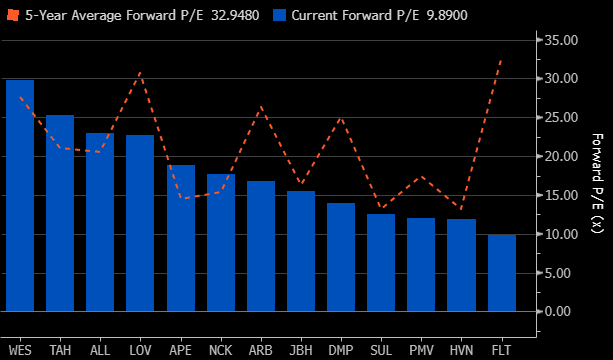
Valuation dispersion across ASX Consumer Discretionary remains wide, ranging from ~30x forward earnings for Lottery Corp, Wesfarmers and Breville to ~10–12x for Flight Centre, Harvey Norman and Premier Investments. Following yesterdays sell-off, JB Hi-Fi sits at ~16x, well below the sector average of ~23.5x, although we’d expect that discount to narrow as consensus earnings forecasts are cut to reflect the weaker trading update.
More broadly, the sector has already undergone a significant valuation reset. Lovisa, ARB, JB Hi-Fi and Premier Investments have suffered the largest de-ratings over the past year, while even higher-quality names such as Wesfarmers and Breville have seen multiples compress. With every constituent de-rating over the past 12 months, notably this is increasingly a sector-wide reset rather than simply a JBH story.
The housing slowdown is becoming an increasingly important fault line for Australian discretionary stocks, with mortgage applications down ~20% at Westpac since the May Budget and falling house prices now weighing on the broader economy. Within the sector, Harvey Norman and Nick Scali carry the greatest direct exposure through furniture and household goods, while Wesfarmers has significant exposure through Bunnings. JB Hi-Fi sits somewhere in the middle, with its appliance businesses more sensitive to housing turnover, a vulnerability highlighted by Monday’s sharp sell-off.
The rest of the sector is far less directly tied to housing, with Aristocrat, Tabcorp, Lovisa, ARB, Super Retail, Domino’s, Flight Centre and Eagers driven more by travel, gaming, autos or broader consumer spending. That distinction is important. if housing turnover remains gridlocked, the earnings pressure is unlikely to be evenly distributed, with big-ticket home and renovation spending sitting firmly in the firing line.
Today we’ve picked five of the more traditional retail stocks as we consider if JBH is still worth holding after yesterday’s sharp fall, especially as the sector has “run hot” into August on falling RBA fears.