After the market closed yesterday PNI delivered a messy FY26 result, with statutory earnings, revenue and inflows ahead of expectations. However, the headline $176.7 million net profit was boosted by a significant non-cash accounting gain, making underlying earnings the more useful measure of performance.
Key results versus Bloomberg consensus:
- Statutory EPS of 78.1c, around 19% ahead of 65.6c expected.
- Statutory NPAT of A$176.7 million, around 20% ahead of $147.3 million expected.
- Revenue of A$109.7 million, around 15% ahead of $95.8 million expected.
- EBIT of A$186.6 million, around 11% ahead of $167.6 million expected.
- EBITDA of A$187.3 million, around 21% ahead of $154.3 million expected.
- Gross margin of 68.4%, versus 66.9% expected.
- Final dividend of 31c per share, up 15% from 27c.
The headline profit needs some context. FY26 statutory NPAT included a A$46 million one-off, non-cash accounting gain following Pinnacle’s acquisition of the remaining interest in Pacific Asset Management, partly offset by A$7 million of net losses on principal investments.
Underlying NPAT of A$130 million, up 21%, is therefore the better measure of Pinnacle’s recurring earnings power. This was below expectations, and particularly so in the 2H ($63.2m).
That said, it still represents a strong result, supported by growth in base management fees and continued expansion across the affiliate platform. Aggregate affiliate FUM increased 28% to $229.4 billion, while net inflows rose 45% to A$33.4 billion. International inflows were the standout, increasing to $12.3 billion from $4.8 billion, while retail inflows rose 48% to $10.2 billion. Domestic institutional inflows remained healthy at $10.9 billion, although modestly below the prior year. This sets up good momentum for FY27.
Acquisitions were also an important contributor to FUM growth, with Pinnacle completing three transactions during FY26. The group has continued that expansion through Pacific Asset Management’s proposed acquisition of UK-based Asset Value Investors. Performance fees were softer, with Pinnacle’s after-tax share falling 24% to $35.6 million. Hyperion was a major influence, and that drag may persist while its performance-fee position rebuilds. Encouragingly, stronger management fees and inflows more than offset the decline.
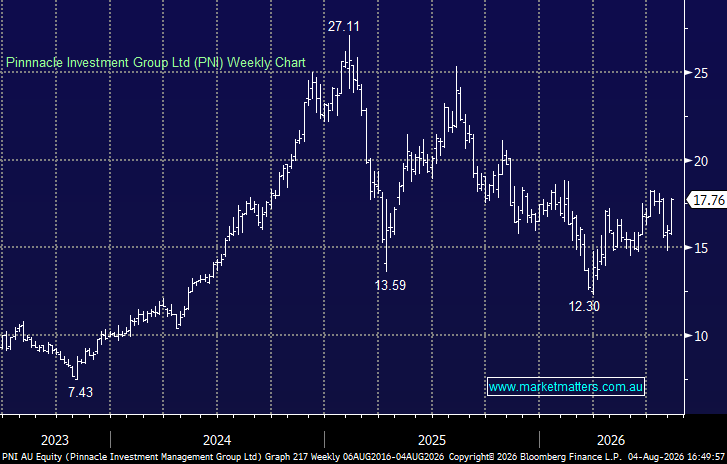
MM’s view: This was a messy underlying result, but the foundations are in place for a good FY27. International and retail inflows were particularly encouraging, reinforcing the scalability of Pinnacle’s multi-affiliate model and reducing its reliance on performance fees. We continue to like PNI and believe its platform model—which others are increasingly attempting to replicate—has significant scope to keep compounding as FUM, distribution and affiliate capabilities expand.
MM remains long & bullish PNI around $17.70
Add To Hit List