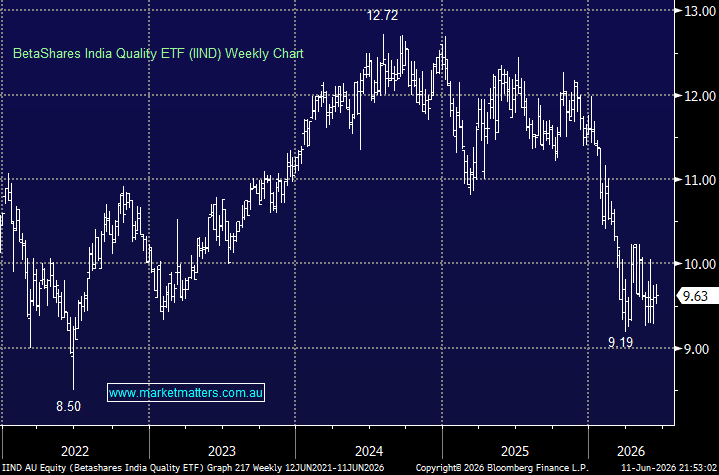
The IIND ETF provides exposure to a portfolio of around 30 of the highest quality Indian companies based on a combined ranking of the following key factors: high profitability, low leverage and high earnings stability. The ETF offers investors a targeted way to access one of the world’s fastest-growing major economies through a rules-based portfolio of market-leading businesses. However, it’s been a tough year for Indian stocks as valuation compression roiled the market after several years of market-beating returns, with earnings struggling to keep pace with expectations, prompting investors to rotate towards alternative and cheaper markets.
While the near-term performance has disappointed, we believe the long-term structural story remains firmly intact, making the recent pullback look more like a consolidation than the end of the bull market – the only question is where to buy. We’ve included the IIND this morning to illustrate that not all stock markets are made equal. This is one that we wouldn’t chase into strength, at least not yet.
The ETF costs 0.80% pa, which we view as reasonable to gain exposure to the Indian market. However, again, the FX exposure has been a drag on performance with its benchmark, the Solactive India Quality Select Index, down 18% over the last year, while the IIND ETF has fallen ~20.3% due to the relatively firm Australian Dollar against the Indian Rupee (INR).
- We can see the IIND ETF making new lows in 2026, but the risk/reward ~$9 will look attractive to us.