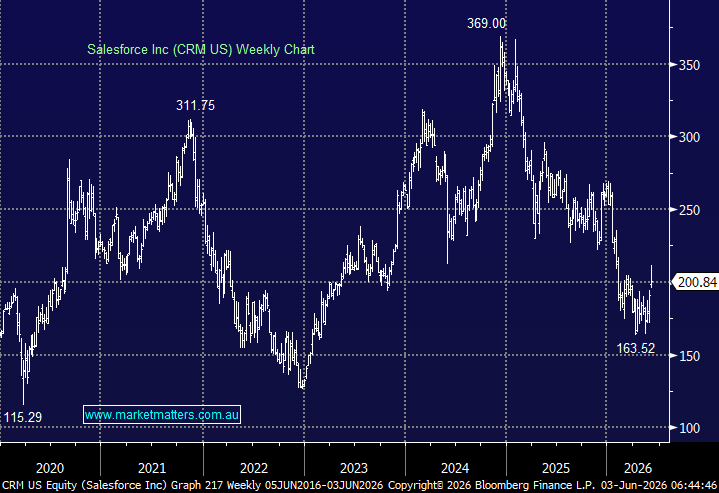
Salesforce (CRM US) has been caught in the aggressive software de-rating, with the stock falling from above US$350 in late 2024 to around US$200 today. That is a significant reset for a business that still has strong recurring revenue, high margins, substantial free cash flow and a net cash balance sheet.
- The market turned sharply against software stocks on AI disruption fears, although we are now starting to see some early signs of interest re-emerge, and for good reason in our view.
Taking a step back, the debate shifted from near-term revenue growth to whether AI disrupts pricing power, seat-based models and long-term margin structures. Salesforce is right in the middle of that debate. It remains one of the world’s most important enterprise software platforms, but investors are questioning whether AI-native tools reduce the need for traditional CRM seats over time. That concern is valid, but we think the sell-off is now discounting a lot of bad news.
Salesforce is still expected to grow revenue from ~$US41.5bn in FY26 to ~$US50.5bn in FY28, with consensus EPS rising from $US12.52 to $US15.59 over the same period. Free cash flow remains very strong, with consensus expecting ~$US14.4bn in FY26, rising to more than US$16bn in FY28. Importantly, this is not a speculative software company burning cash to chase growth; Salesforce is a mature, highly profitable enterprise platform with scale.
The valuation is now the most interesting piece of the puzzle. On consensus numbers, it is trading on a mid-teens earnings multiple, around 10x forward EBITDA and a low-teens free cash flow multiple. For a business of this quality, with this level of profitability and cash generation, that looks interesting to MM.
- When we write about software stocks, we consistently emphasise the importance of enterprise data access, deep customer relationships and embedded platforms that are difficult and costly to displace. Salesforce fits that description.
We also think Salesforce has a credible AI strategy. Agentforce is aimed at embedding AI agents into customer workflows rather than simply defending the old seat-based revenue model. If Salesforce can show that AI increases customer value, improves retention and creates new monetisation opportunities, it will go a long way toward proving the market has become too pessimistic.
The counterargument is that growth keeps slowing, AI pressures seat growth, customers scrutinise software spend more aggressively, and Salesforce struggles to reaccelerate organically. Revenue growth is still good, but not spectacular, and for a company of Salesforce’s size, sustaining high-single-digit to low-double-digit growth requires consistent execution. The market is also less forgiving of M&A-led expansion than it was in the past, particularly after large deals such as Slack, which Salesforce bought in 2021.
The key for MM is how deeply embedded Salesforce is within enterprise workflows. Large companies do not easily rip out their CRM, service, marketing and data infrastructure, as the costs and operational risks are high. That gives Salesforce time to adapt its model and monetise AI, even if the transition is not linear.
The technical picture also reflects how negative sentiment has become. Salesforce has materially underperformed over the past 12-months, and the share price is now back near levels seen in 2022, despite the company being larger, more profitable and more cash generative today.
We would not describe CRM as a high-growth multiple expansion story anymore. The more realistic view is that it is becoming a value-in-software opportunity: a dominant enterprise platform, trading on a reasonable multiple, with strong cash generation, a solid balance sheet and enough growth to justify a higher valuation if execution stabilises.
We are interested in CRM around current levels and are considering it for the International Equities Portfolio. We think the worm is turning for beaten-up software, and the move is likely to be more than just a counter-trend bounce. Gains from depressed levels can come quickly, and we are now looking to add select software exposure into our International Growth Strategy.
- On ~15x forward earnings, the market does not need Salesforce to return to hyper-growth; it simply needs the business to prove it is not ex-growth.
MM is now bullish CRM ~$US200
Add To Hit List