Hi Judy,
We provide general advice, meaning we don’t say what any one individual investor should do in these notes – so in that context…
QUAL is a good-quality core global equity ETF in our view, meaning it screens for companies with strong balance sheets, high return on equity, stable earnings and lower leverage. That naturally gives it exposure to a number of high-quality global technology names, but the portfolio is broader than just AI or semiconductors. We see it more as a long-term core global equity holding rather than a targeted thematic exposure.
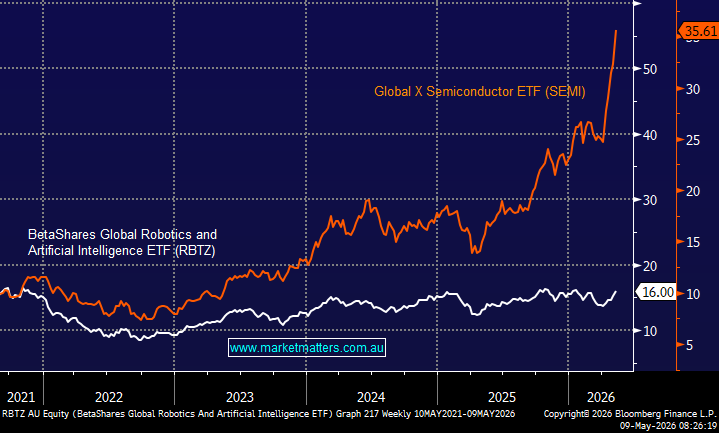
On RBTZ versus SEMI or AINF, the underlying exposures are important:
- RBTZ gives exposure to robotics, automation and AI-adjacent companies. It has been a good thematic exposure, but it is generally broader and more diversified across industrial automation, robotics, sensors, software and enabling technologies. That means it can benefit from AI-related capex, but it is not the purest way to play AI infrastructure.
- SEMI is more targeted. It is focused on the semiconductor supply chain, which remains one of the clearest beneficiaries of AI demand, particularly through chips, equipment, foundries and related hardware. The trade-off is that it is more cyclical and can be a lot more volatile, but the linkage to AI infrastructure is more direct than RBTZ.
- AINF sits somewhere different again. It is more focused on the broader AI infrastructure ecosystem, which can include data centres, cloud infrastructure, power, connectivity and related enablers. In that sense, it may provide a broader “picks and shovels” exposure to the AI build-out, rather than being concentrated purely in semiconductor names.
From our perspective, we would not necessarily switch purely because RBTZ has performed well. If the position size is sensible and it still fits the role in the portfolio, there is a case for continuing to hold it. However, if the aim is to sharpen the AI exposure, we would generally prefer SEMI for the most direct AI hardware exposure, or AINF for a broader AI infrastructure angle.