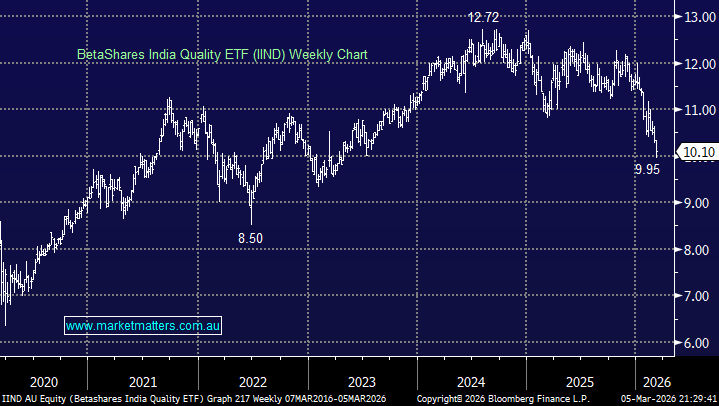
Indian equities have struggled in 2026, pressured by lofty valuations, foreign outflows, rising oil prices and heightened global uncertainty, although the market effectively peaked back in 2024. India also finds itself awkwardly positioned amid the US–Iran conflict. While stopping short of condemning the US-Israeli strikes, Foreign Secretary Vikram Misri signed the condolence book for Ayatollah Ali Khamenei at the Iranian embassy in New Delhi this week, highlighting the country’s longstanding ties with Tehran, a former major oil supplier. At the same time, relations with Washington remain delicate, after the US imposed punitive 50% tariffs on Indian exports last year, before later striking a deal that reduced the duties.
India is clearly one of the more vulnerable economies in Asia to the fallout from the war, given its heavy dependence on imported crude and energy shipments that transit the strategic Strait of Hormuz, and we think it’s too early to fight the correction considering the macro backdrop. The ASX-traded IIND ETF gives excellent exposure to the Indian market for 0.8% pa, good value in our opinion, considering how hard it can be for many retail investors to buy Indian shares directly, but we can see a further 10% downside from current levels.
- We can see the IIND ETF testing the $8.50-9 support area in the coming weeks/months as oil pushes higher.