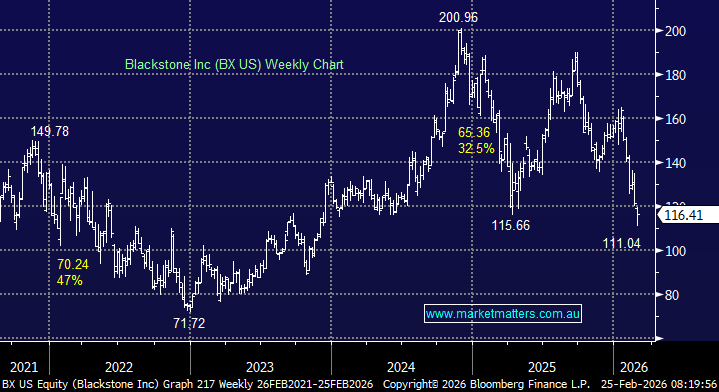
Blackstone has been caught up in the latest sell-off across alternative managers as markets zero in on private credit’s exposure to software, and the growing concern that AI could compress SaaS moats, pressure cashflows and ultimately lift default risk. This isn’t about a single credit event – it’s about a broader repricing of risk. If software valuations and confidence fall, lenders tighten, refinancing windows narrow, and mark-to-market pain starts to surface across private credit vehicles.
The anxiety is being fuelled by the AI-disruption narrative, with investors increasingly uncomfortable that parts of the credit market may have underwritten yesterday’s software business models. That concern is starting to show up in the data. Morningstar DBRS has flagged that downgrades are now outpacing upgrades, with default rates lifting to around ~4% as at February 2026. This is not a crisis – but directionally, the trend is clearly moving the wrong way.
Concerns around liquidity have added fuel to the fire. Blue Owl (OWL US), a major global alternatives manager with ~US$300bn of AUM, recently announced that one of its large retail-facing private credit funds – Blue Owl Capital Corp II (OBDC II) – would no longer offer its usual quarterly redemptions. Instead, capital will be returned through episodic distributions as assets are realised. While fund-specific, the move has amplified the market narrative that “software + private credit” is guilty until proven innocent.
Against that backdrop, it’s worth separating perception from exposure. Blackstone does lend to software companies, but software is not central to the firm, and underwriting standards appear conservative:
- Software = ~7% of total Blackstone AUM
- Software = ~10% of Blackstone’s credit platform
- Average loan-to-value <40% at origination (i.e., big equity buffer)
- Average software Total Enterprise Value (TEV) > US$4bn (larger, more resilient issuers)
None of this makes Blackstone immune. We agree that defaults in software are likely to rise, and recent commentary warning of stress in parts of the sector shouldn’t be ignored. That’s not a friendly environment for creditors. That said, Blackstone’s exposure is clearly tilted toward the larger end of the market, which should – at least in theory – prove more resilient than sub-scale or venture-style SaaS borrowers.
- We’ve already made changes within the International Equities Portfolio to reduce overall software exposure, most recently selling Zillow (ZG US) and Alphabet (GOOGL US). We still hold selective positions, and BX US is one of them – though it remains under pressure and continues to trade on a relatively full ~29x FY26 earnings multiple.
While we think the sell-off looks overdone on the information available today, the risks have risen materially over recent months. Owning software-linked credit is not where we want to be positioned as uncertainty builds. Blackstone’s exposure is modest relative to its overall AUM, and the stock is clearly being swept up in a sector-wide fear trade, but these episodes can linger longer than fundamentals alone would suggest.
Put simply, we’re torn: positive on the medium-term outlook for what we still regard as the world’s best alternative asset manager, but wary of how long concerns around software credit and defaults may continue to dominate sentiment.
- For now, we are holding, but we intend to reduce our ~6% position if conditions deteriorate further.
MM is cautiously bullish on BX US ~$113
Add To Hit List