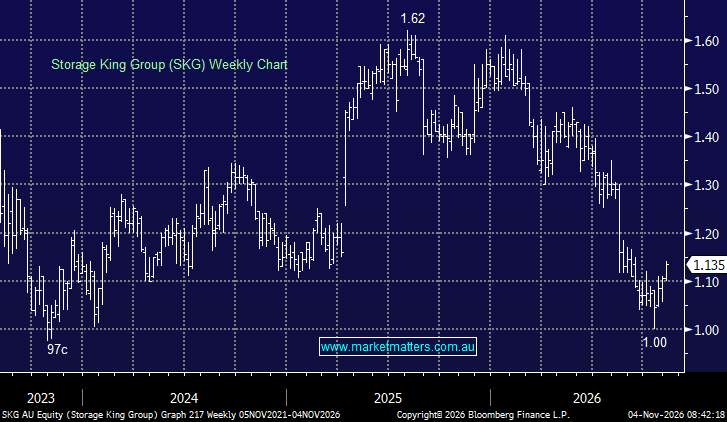
Storage King Group (SKG) owns 149 self-storage assets across Australia and New Zealand, comprising 130 operating stores and 19 development sites, with around 696,000sqm of storage space worth approximately $3.5bn.
The share price has been hit hard this year amid broader property headwinds, amplified by a significant cut to FY27 distribution guidance, with expected income reduced 27% to 4.5c per security. For a yield security, a downgrade of that magnitude understandably raises questions and has been a major contributor to the sell-off.
However, the cut was more about cash flow and capital allocation than a deterioration in the underlying storage business. SKG is carrying a sizeable development pipeline while higher interest costs have reduced free cash available for distributions. Management has effectively chosen to retain more cash to fund developments, strengthen the balance sheet and reduce reliance on external capital rather than maintain the previous payout.
The stock is now trading around $1.13, compared with June NTA of $1.77, implying a discount of roughly 36%. That is a substantial gap for an established self-storage portfolio with recurring revenues and relatively defensive demand characteristics.
There is also obvious corporate appeal. Abacus Group recently agreed to exit its entire 19.6% holding, raising approximately $285m. The transaction included a 9.23% institutional block at $1.00 and a strategic sale of 10.37% to Ki Corporation at $1.20.
Ki, backed by billionaire Nathan Kirsh, is not a passive shareholder. Alongside US self-storage giant Public Storage, it attempted to take over SKG in 2025, initially bidding $1.47 before increasing the proposal to $1.65. The consortium ultimately withdrew after due diligence when it failed to reach agreement with SKG’s independent directors.
The fact Ki has now acquired a further stake from Abacus suggests its interest in the business remains significant. That history is difficult to ignore with SKG trading roughly one-third below the previous $1.65 proposal and materially below NTA. Importantly, the Abacus selldown also removes a sizeable overhang. Abacus was seeking to recycle capital and reduce gearing, so its willingness to sell at $1.00–1.20 should not necessarily be viewed as an assessment of SKG’s underlying value.
- The trade is not without risk. A controlling shareholder can reduce the likelihood of a competing bidder emerging, while NTA is not the same as realisable value — property valuations, gearing and transaction costs all matter. There is also no guarantee Ki revisits a takeover.
However, since National Storage, which we owned at the time, was taken private by Brookfield and GIC in May, SKG is now the only listed pure-play self-storage REIT on the ASX. We think the stock looks attractive on fundamentals alone, with the current share price implying a substantial discount to its underlying property portfolio.
At around $1.13 versus $1.77 NTA, we think investors are being well compensated for the uncertainty. A renewed privatisation attempt would provide additional upside rather than being required to justify the investment case.