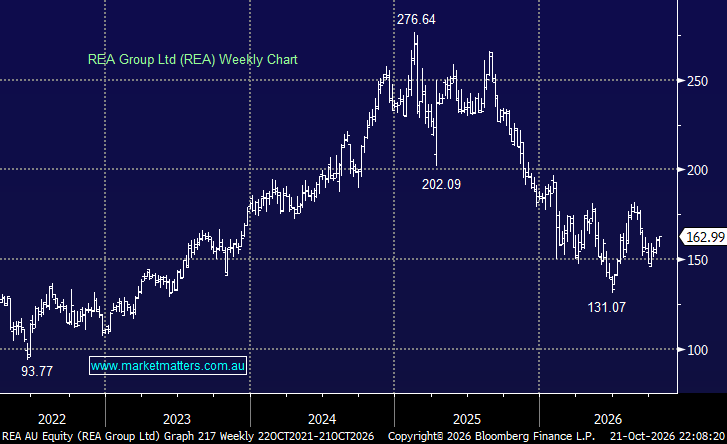
REA Group (REA) rose 2.7% on Wednesday as buyers returned to the online classifieds sector, although it lagged SEEK (SEK) and CAR Group (CAR), most likely reflecting ongoing concerns around the Australian housing market. REA’s decline over the past 12 months can largely be attributed to three compounding headwinds: AI disruption fears that drove a sector-wide de-rating from late 2025, a sharp 1H earnings miss in February 2026, and federal budget policy changes that threatened listing volumes and triggered another round of broker downgrades in June. Adding to the uncertainty is the prospect of greater competition from Domain under a well-capitalised new owner. Domain is coming off a low base, and increased investment could present a more meaningful challenge to REA’s long-standing market dominance.
These headwinds have prompted a 40% re-rate lower in the shares, pushing its valuation~33% below its medium-term average.
- The sharp drop in share price is understandable, it couldn’t really get much worse for REA, however despite that, they’re still growing earnings at strong rates (mid-teens), and any glimmer of hope that Australian house prices have stopped falling, and more importantly, turnover is improving, and REA is likely to be sharply rerated on the upside.
The stock has partially recovered from its June low as FY26 earnings beat on the key profit line as the company demonstrated pricing power despite volume weakness. Looking to 2030, the growth case rests on sustained double-digit yield growth, AI-driven product differentiation, financial services scaling, and international expansion — with Distilled in Ireland the most recent and strategically significant step.
- In FY26, basically all of REA’s revenue was generated in Australia, hence its correlation to the deteriorating local housing market.
Moving forward, REA’s international revenue is likely to remain modest through 2030, with India tracking at roughly 2–3% of total revenue. However, the earnings contribution from international associates (Move, Distilled, iGUIDE) could be materially larger if those businesses scale as intended. Hence, at least for the next year or two, this is a local property play combined with bonds and sector valuation improvement – a scary mix, which is why the stock is over $100 below its 2025 high.
- We can see REA recovering in 2027 from depressed levels, but the combination of weak macro and increased competition from Domain has us more uneasy about REA relative to others.
MM is cautiously bullish towards REA around $163
Add To Hit List