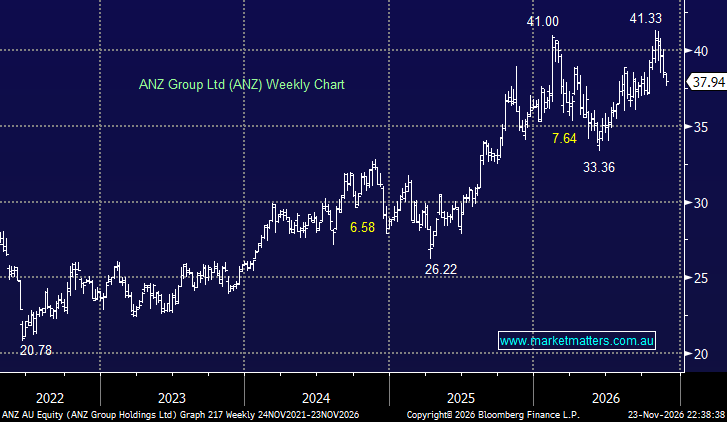
MM is underweight the “Big Four” banks in our large cap strategies; The Growth Portfolio recently took profit on Westpac (WBC), pivoting into Macquarie Group (MQG) to reduce exposure to Australian property and rising bad debts from a soft economy while gaining exposure to offshore earnings. The Income Portfolio still holds Westpac and ANZ, having a greater bias for income, but we’re underweight in both strategies.
For Australian banks, a recession would create four main risks for earnings:
- Higher bad debts and loan losses: Rising unemployment and weaker household incomes increase mortgage arrears and defaults, while struggling businesses are more likely to miss repayments or enter insolvency.
- Falling credit growth: Households and businesses become more cautious, reducing demand for mortgages, business loans and other credit. Slower lending growth would weigh on banks’ revenue.
- Pressure on net interest margins: The RBA may cut interest rates to support the economy. While this can reduce banks’ funding costs, mortgage rates can fall faster than deposit costs, squeezing margins.
- Weaker housing and collateral values: A recession could put further downward pressure on property prices, increasing loan-to-value ratios and the potential loss banks face if borrowers default.
All of the above is potentially old news, with the banks already having put increasing amounts of money aside for rising bad debts. However, arguably the biggest issue for the ASX banks is that they’re expensive, with ANZ trading ~17% above its 5-year average PE. Hence, at this stage, we see little upside in the sector, while downside risks become more elevated if the economy deteriorates.
ANZ remains our preferred bank given it’s got the most levers to pull to improve financial returns, but from a portfolio perspective, we are comfortable holding an underweight exposure to the sector.
- MM likes being underweight the banks on valuation terms in an economy that’s close to a coin toss.

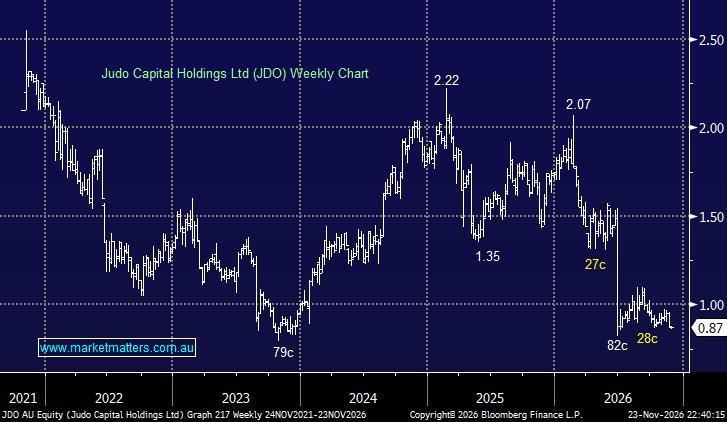
Judo Group (JDO), which primarily lends money to small businesses, illustrates the pain being felt across this critical part of the Australian economy. Small businesses with 0-19 employees are by far the largest employer in Australia. Small businesses going broke is adding further weight to the country’s employment issue and our view that interest rates will be cut twice in 2027.
- JDO has fallen 60% from its 2025 high for reasons touched on before.
However, as we looked at before, markets turn when things look their worst, and there’s already plenty of bad news built into JDO’s share price.
- We may consider JDO in another leg lower below 80c, but for now the macro backdrop nullifies the risk/reward for us.