Charter Hall is launching a new listed investment opportunity into what we think is a genuinely interesting part of the market: listed property trading at significant discounts to net tangible assets (NTA), at a time when we believe Australian interest rates are at their cyclical peak.
The concept makes sense. CDV will raise up to $200m and invest in a concentrated portfolio of up to 20 ASX-listed property securities, targeting high-quality assets with recurring rental income and meaningful discounts to intrinsic value and NTA. It is targeting a 10%+ total return, with quarterly distributions and a minimum 5% distribution yield on the $5.00 offer price for the first two years.
- Importantly, CDV is not buying buildings directly. It is buying listed property securities that already own the buildings.
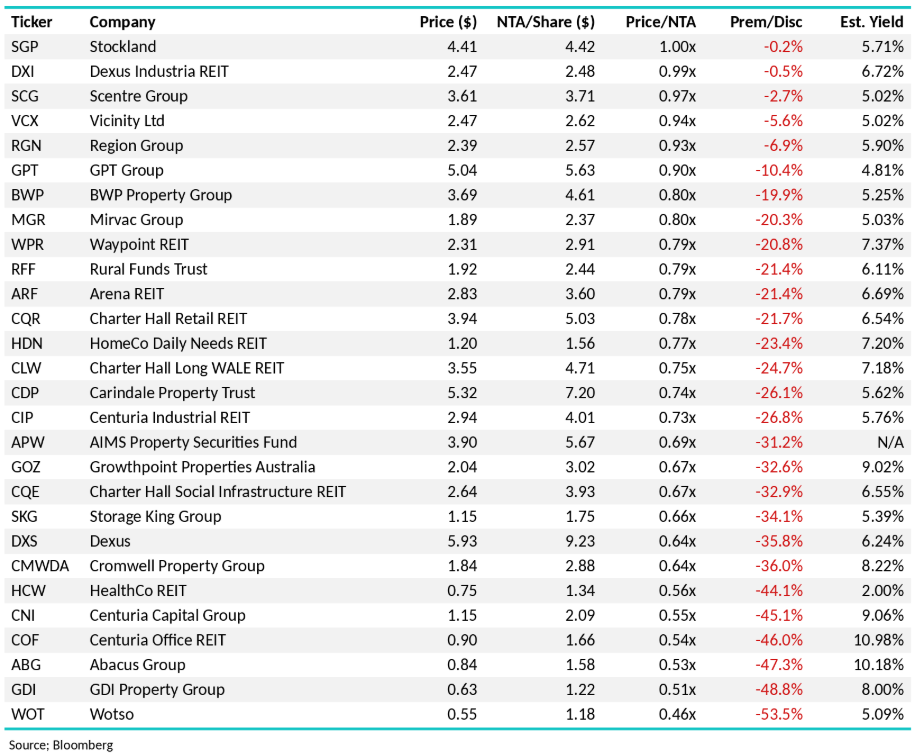
The majority of A-REITs are still trading below NTA, many offer yields in the 5–7% range, and if bond yields and interest rates begin to fall, the sector could benefit from both income and a narrowing of those valuation discounts. For an income-focused investor, we think this strategy has merit, and we hold a very similar view to Charter Hall around the timing of investing in REITs i.e. it’s a good time now.
However, our concern is that CDV adds another layer between the investor and the underlying assets. Investors are effectively paying Charter Hall to select from a universe of already-discounted listed property securities, with a management fee of 1.29% p.a. plus performance fees. There is also the possibility of a double discount i.e. the underlying REITs may trade below their own NTAs, while CDV itself could also trade below the value of its portfolio once listed.
There are some positives in the design – the Trust will carry no leverage at the fund level, Charter Hall is co-investing alongside investors, a seed portfolio allows rapid deployment, and the seven-year liquidity event provides some mechanism to address the risk of a persistent discount, if it were to materialise.
The seven-year review point is interesting. At that time, unitholders will vote on whether the Trust should be wound up. If it continues, there is also a mechanism for investors who want to exit to have their units bought back at a price linked to the prevailing NTA per unit, subject to the terms of the liquidity sale process. Importantly, this is not the same as a guaranteed maturity at $5.00. The exit value would depend on the portfolio’s NTA at that time, which could be higher or lower than the original offer price. However, it does provide investors with a potential pathway to realise something closer to underlying asset value if CDV is trading at a material discount on the ASX.
Ultimately, we like the thematic more than we like the need for the vehicle. The Income Portfolio is already positioned to benefit from the same macro setup through direct A-REIT exposures, where we can select securities ourselves, avoid an additional layer of fees and focus on individual stocks trading at attractive discounts to NTA with sustainable income.
That said, CDV is a sensible product for investors wanting diversified, professionally managed exposure to the listed property sector. However, for the Income Portfolio, we would rather continue to do the work ourselves and selectively own the underlying opportunities directly. The launch does reinforce one important point: value is emerging across listed property, which is an area we continue to like at current levels.
- Of the REITs below, we currently own MGR (Growth & Income Portfolios), CLW (Income Portfolio) & SKG + CNI (Emerging Companies Portfolio).