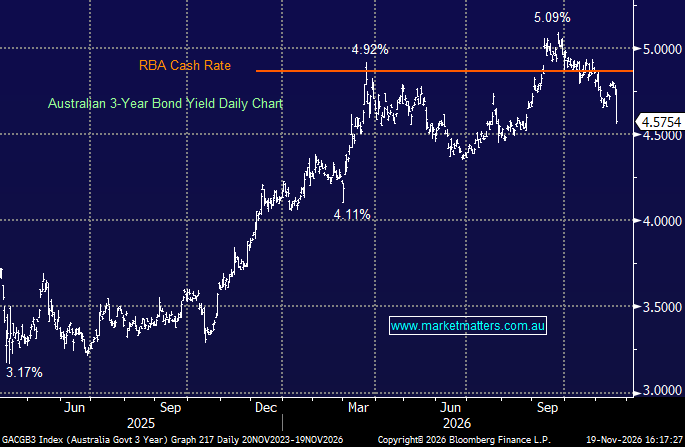
Australia’s October employment report was a clear downside surprise and has materially changed the interest-rate debate. Employment fell by 44,000 jobs, compared with expectations for a gain of more than 25,000, while unemployment rose to a cycle-high 4.9%. Coming after another weak employment report, the data confirms the labour market is softer than the RBA expected.
Markets have responded accordingly. Expectations for another rate hike have effectively disappeared, while around 40bps of rate cuts are now priced by the end of 2027. That does not mean the RBA is about to cut. Inflation remains too high, and the Central Bank will want to see clearer evidence that capacity pressures are easing before changing course. CBA and ANZ both expect the RBA to remain on hold in December, while UBS has now brought forward its first expected cut to August 2027, followed by further easing later that year.
Household spending is slowing, the housing market is correcting, business confidence and forward orders are weakening, and now the labour market is clearly softening. HSBC has gone as far as saying the risk of recession is increasing.
The Australian dollar fell on the data, down to around US66.6c, as markets moved from debating another hike to increasingly considering when the first cut might arrive. The key takeaway is that the balance of risks has shifted. Inflation remains the constraint, but the economy is now showing enough weakness that another rate hike looks increasingly difficult to justify.
For markets, that is significant. If the labour market continues to deteriorate while inflation gradually moderates, the next move in rates will be down. With 40bps of easing now priced by the end of 2027, markets are beginning to reflect that change well before the RBA itself is ready to signal it. At MM, we’ve been in the camp that the next move will be down, and today’s data is supportive of that.