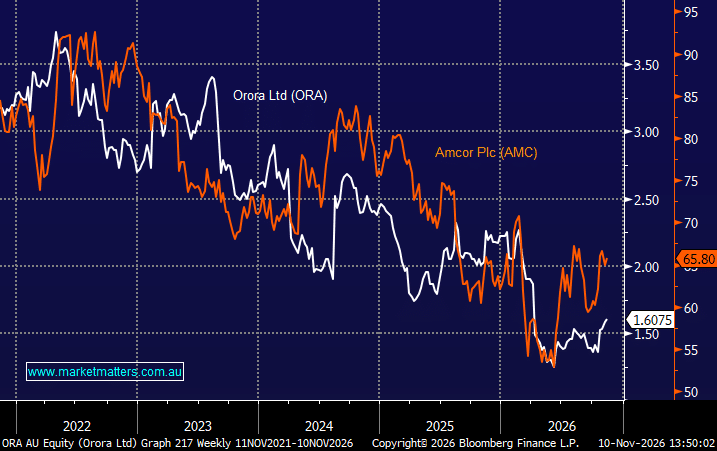
This week we’ve looked into Orora, as much because it’s gained traction over the last month, advancing ~15%, but also because alternative Amcor (AMC), which we own, delivered an average 1Q27 result, leaving the stock in ORA’s wake, having only gained ~9% – although both are outperforming the ASX 200. In other words, we are questioning if we are still backing the correct horse.
ORA is a $2bn business that primarily manufactures glass bottles and aluminium cans, with a strong focus on beverage packaging, particularly wine, beer and spirits. Amcor (AMC) is a $30bn giant and has a much broader global packaging business, specialising in flexible and rigid packaging across food, beverages, healthcare, pharmaceuticals and personal care. In simple terms, Orora is more concentrated in beverage packaging, while Amcor offers greater product and end-market diversification – remember, people are drinking less!
The global packaging industry is going through period of structural change, with sustainability regulations, recycling requirements and growing demand across Asia-Pacific expected to drive growth through 2030. Governments are increasingly mandating recyclable packaging and higher recycled content, particularly in Europe, accelerating the shift towards paper-based materials, recycled plastics and aluminium. Demand for recycled plastic packaging is forecast to double by 2030, while recycled PET is expected to grow significantly faster than virgin plastic.
These trends present attractive long-term opportunities: Amcor is investing in sustainable coatings and fibre-based packaging, while Orora’s glass and aluminium packaging exposure provides opportunities as customers seek alternatives to traditional plastics. Automation, digital printing and improved recycling technology should also support productivity and innovation. Of the two, ORA looks slightly better positioned to benefit directly from increasing demand for recycled packaging, particularly in Australia:
- ORA – Its FY26 results showed recycled content of 65% in colour glass and 77% in aluminium cans, with targets of 68% and 80% respectively.
- AMC – broader global opportunity, given its exposure to food, beverage, healthcare and consumer packaging. It reported that 78% of its FY26 packaging production by weight was recyclable or recycle-ready.
However, there are always different ways of evaluating stocks; in simple terms, AMC is a global consolidation and synergy story that pays an almost 6% yield. ORA is a cans business carrying a broken glass division that also pays a solid ~5.5% yield. Yield is nice, but we also want some growth moving forward.
Last week, AMC delivered a relatively soft 1Q27 result, with EPS at the midpoint of guidance but 1% below consensus, as higher-than-expected energy and distribution costs offset improving volumes. Core portfolio volumes grew 1.5%, accelerating from 0.5% in the previous quarter and marking the 4th consecutive quarter of sequential improvement. However, management lowered 1H EPS guidance by approximately 5% due to delays in passing through higher energy costs, while reiterating its US$650mn synergy target over three years following the Berry acquisition. Despite near-term cost pressures, management expects double-digit EPS growth in CY27.
- AMC is on an ok valuation ~12.7x, having bounced well following the initial knee-jerk ~8% drop after its 1Q update – it’s down slightly MTD as it heads into its dividend later this month.
In August, Orora delivered FY26 earnings broadly in line with expectations, down 5% year-on-year, as 7% growth in Cans offset an 18% decline at Saverglass – its ~$2.2bn acquisition made in 2023. The company also announced a substantial $743mn non-cash impairment against Saverglass. Looking ahead, FY27 EBIT is expected to decline from FY26’s $248mn, with Saverglass weakness, US tariffs and Middle East-related supply-chain disruption weighing on earnings. Cans remain the bright spot, with expected volume growth of 4–6%, but subdued wine and spirits demand will weigh on near-term earnings, partly offset by the resumption of share buybacks.
- ORA is more expensive, trading on 15.5x with no dividends payable until 2027 and a major problem in Saverglass.
At this stage, we view AMC as the better prospect in this space; it has scale, a synergy runway and a growing dividend, while deleveraging should do the heavy lifting for the share price. Conversely, ORA is a potential value trap until Saverglass is fixed or sold. The cans business is quality, but it’s small in the scheme of things. A Saverglass turnaround is key for ORA to compound its recent outperformance, although as the chart below illustrates, both stocks have danced together over recent years.
- We are neutral towards ORA and cautiously bullish toward AMC, but packaging trends will be monitored closely moving forward.
MM prefers AMC over ORA into 2027
Add To Hit List